


Super-prime numbers, also known as higher-order primes or prime-indexed primes (PIPs), are the subsequence of prime numbers that occupy prime-numbered positions within the sequence of all prime numbers. In other words, if prime numbers are matched with ordinal numbers, starting with prime number 2 matched with ordinal number 1, then the primes matched with prime ordinal numbers are the super-primes.
The subsequence begins
- 3, 5, 11, 17, 31, 41, 59, 67, 83, 109, 127, 157, 179, 191, 211, 241, 277, 283, 331, 353, 367, 401, 431, 461, 509, 547, 563, 587, 599, 617, 709, 739, 773, 797, 859, 877, 919, 967, 991, ... (sequence A006450 in the OEIS).
That is, if p(n) denotes the nth prime number, the numbers in this sequence are those of the form p(p(n)).
| n | 1 | 2 | 3 | 4 | 5 | 6 | 7 | 8 | 9 | 10 | 11 | 12 | 13 | 14 | 15 | 16 | 17 | 18 | 19 | 20 |
|---|---|---|---|---|---|---|---|---|---|---|---|---|---|---|---|---|---|---|---|---|
| p(n) | 2 | 3 | 5 | 7 | 11 | 13 | 17 | 19 | 23 | 29 | 31 | 37 | 41 | 43 | 47 | 53 | 59 | 61 | 67 | 71 |
| p(p(n)) | 3 | 5 | 11 | 17 | 31 | 41 | 59 | 67 | 83 | 109 | 127 | 157 | 179 | 191 | 211 | 241 | 277 | 283 | 331 | 353 |
In 1975, Robert Dressler and Thomas Parker used a computer-aided proof (based on calculations involving the subset sum problem) to show that every integer greater than 96 may be represented as a sum of distinct super-prime numbers.[1] Their proof relies on a result resembling Bertrand's postulate, stating that (after the larger gap between super-primes 5 and 11) each super-prime number is less than twice its predecessor in the sequence.
A 2009 research showed that there are
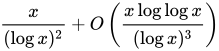
super-primes up to x.[2] This can be used to show that the set of all super-primes is small.[3]
One can also define "higher-order" primeness much the same way and obtain analogous sequences of primes.[4]
A variation on this theme is the sequence of prime numbers with palindromic prime indices, beginning with
References
edit- ^ Dressler, Robert E.; Parker, S. Thomas (1975). "Primes with a Prime Subscript". Journal of the ACM. 22 (3): 380–381. doi:10.1145/321892.321900. ISSN 0004-5411. Retrieved May 30, 2025.
- ^ Broughan, Kevin A.; Barnett, A. Ross (December 5, 2008). "On the Subsequence of Primes Having Prime Subscripts". University of Waterloo. Retrieved May 30, 2025.
- ^ Bayless, Jonathan; Klyve, Dominic; Oliveira e Silva, Tomas (May 9, 2014). "NEW BOUNDS AND COMPUTATIONS ON PRIME-INDEXED PRIMES". Integers. DE GRUYTER. p. 613–633. doi:10.1515/9783110298161.613. ISBN 978-3-11-029811-6.
- ^ Fernandez, Neil (August 8, 1999). "Fernandez's Order of Primeness". The Borve Pages. Retrieved May 30, 2025.
External links
edit | This number theory–related article is a stub. You can help Wikipedia by adding missing information. |
