


A simplicial map (also called simplicial mapping) is a function between two simplicial complexes, with the property that the images of the vertices of a simplex always span a simplex.[1] Simplicial maps can be used to approximate continuous functions between topological spaces that can be triangulated; this is formalized by the simplicial approximation theorem.
A simplicial isomorphism is a bijective simplicial map such that both it and its inverse are simplicial.
Definitions
editA simplicial map is defined in slightly different ways in different contexts.
Abstract simplicial complexes
editLet K and L be two abstract simplicial complexes (ASC). A simplicial map of K into L is a function from the vertices of K to the vertices of L, , that maps every simplex in K to a simplex in L. That is, for any , .[2]: 14, Def.1.5.2 As an example, let K be the ASC containing the sets {1,2},{2,3},{3,1} and their subsets, and let L be the ASC containing the set {4,5,6} and its subsets. Define a mapping f by: f(1)=f(2)=4, f(3)=5. Then f is a simplicial mapping, since f({1,2})={4} which is a simplex in L, f({2,3})=f({3,1})={4,5} which is also a simplex in L, etc.



If is not bijective, it may map k-dimensional simplices in K to l-dimensional simplices in L, for any l ≤ k. In the above example, f maps the one-dimensional simplex {1,2} to the zero-dimensional simplex {4}.

If is bijective, and its inverse is a simplicial map of L into K, then is called a simplicial isomorphism. Isomorphic simplicial complexes are essentially "the same", up to a renaming of the vertices. The existence of an isomorphism between L and K is usually denoted by .[2]: 14 The function f defined above is not an isomorphism since it is not bijective. If we modify the definition to f(1)=4, f(2)=5, f(3)=6, then f is bijective but it is still not an isomorphism, since is not simplicial: , which is not a simplex in K. If we modify L by removing {4,5,6}, that is, L is the ASC containing only the sets {4,5},{5,6},{6,4} and their subsets, then f is an isomorphism.



Geometric simplicial complexes
editLet K and L be two geometric simplicial complexes (GSC). A simplicial map of K into L is a function such that the images of the vertices of a simplex in K span a simplex in L. That is, for any simplex , . Note that this implies that vertices of K are mapped to vertices of L. [1]


Equivalently, one can define a simplicial map as a function from the underlying space of K (the union of simplices in K) to the underlying space of L, , that maps every simplex in K linearly to a simplex in L. That is, for any simplex , , and in addition, (the restriction of to ) is a linear function.[3]: 16 [4]: 3 Every simplicial map is continuous.
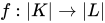


Simplicial maps are determined by their effects on vertices. In particular, there are a finite number of simplicial maps between two given finite simplicial complexes.
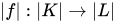
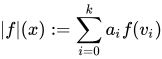
A simplicial map between two ASCs induces a simplicial map between their geometric realizations (their underlying polyhedra) using barycentric coordinates. This can be defined precisely.[2]: 15, Def.1.5.3 Let K, L be two ASCs, and let be a simplicial map. The affine extension of is a mapping defined as follows. For any point , let be its support (the unique simplex containing x in its interior), and denote the vertices of by . The point has a unique representation as a convex combination of the vertices, with and (the are the barycentric coordinates of ). We define . This |f| is a simplicial map of |K| into |L|; it is a continuous function. If f is injective, then |f| is injective; if f is an isomorphism between K and L, then |f| is a homeomorphism between |K| and |L|.[2]: 15, Prop.1.5.4


Simplicial approximation
editLet be a continuous map between the underlying polyhedra of simplicial complexes and let us write for the star of a vertex. A simplicial map such that , is called a simplicial approximation to .



A simplicial approximation is homotopic to the map it approximates. See simplicial approximation theorem for more details.
Piecewise-linear maps
editLet K and L be two GSCs. A function is called piecewise-linear (PL) if there exist a subdivision K' of K, and a subdivision L' of L, such that is a simplicial map of K' into L'. Every simplicial map is PL, but the opposite is not true. For example, suppose |K| and |L| are two triangles, and let be a non-linear function that maps the leftmost half of |K| linearly into the leftmost half of |L|, and maps the rightmost half of |K| linearly into the rightmost half of |L|. Then f is PL, since it is a simplicial map between a subdivision of |K| into two triangles and a subdivision of |L| into two triangles. This notion is an adaptation of the general notion of a piecewise-linear function to simplicial complexes.
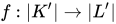
A PL homeomorphism between two polyhedra |K| and |L| is a PL mapping such that the simplicial mapping between the subdivisions, , is a homeomorphism.
References
edit- ^ a b Munkres, James R. (1995). Elements of Algebraic Topology. Westview Press. ISBN 978-0-201-62728-2.
- ^ a b c d Matoušek, Jiří (2007). Using the Borsuk-Ulam Theorem: Lectures on Topological Methods in Combinatorics and Geometry (2nd ed.). Berlin-Heidelberg: Springer-Verlag. ISBN 978-3-540-00362-5.
Written in cooperation with Anders Björner and Günter M. Ziegler
, Section 4.3 - ^ Colin P. Rourke and Brian J. Sanderson (1982). Introduction to Piecewise-Linear Topology. New York: Springer-Verlag. doi:10.1007/978-3-642-81735-9. ISBN 978-3-540-11102-3.
- ^ Bryant, John L. (2001-01-01), Daverman, R. J.; Sher, R. B. (eds.), "Chapter 5 - Piecewise Linear Topology", Handbook of Geometric Topology, Amsterdam: North-Holland, pp. 219–259, ISBN 978-0-444-82432-5, retrieved 2022-11-15
{{citation}}: CS1 maint: work parameter with ISBN (link)

