In mathematics, signal processing and control theory, a pole–zero plot is a graphical representation of a rational transfer function in the complex plane which helps to convey certain properties of the system such as:
- Stability
- Causal system / anticausal system
- Region of convergence (ROC)
- Minimum phase / non minimum phase

A pole-zero plot shows the location in the complex plane of the poles and zeros of the transfer function of a dynamic system, such as a controller, compensator, sensor, equalizer, filter, or communications channel. By convention, the poles of the system are indicated in the plot by an X while the zeros are indicated by a circle or O.
A pole-zero plot is plotted in the plane of a complex frequency domain, which can represent either a continuous-time or a discrete-time system:
- Continuous-time systems use the Laplace transform and are plotted in the s-plane:
- Real frequency components are along its vertical axis (the imaginary line where )
- Discrete-time systems use the Z-transform and are plotted in the z-plane:
- Real frequency components are along its unit circle


Continuous-time systems
editIn general, a rational transfer function for a continuous-time LTI system has the form:

where
- and are polynomials in ,
- is the order of the numerator polynomial,
- is the th coefficient of the numerator polynomial,
- is the order of the denominator polynomial, and
- is the th coefficient of the denominator polynomial.


Either or or both may be zero, but in real systems, it should be the case that ; otherwise, the gain would be unbounded at high frequencies.

Poles and zeros
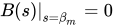
edit- the zeros of the system are roots of the numerator polynomial: such that
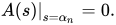
- the poles of the system are roots of the denominator polynomial: such that


Region of convergence
editThe region of convergence (ROC) for a given continuous-time transfer function is a half-plane or vertical strip, either of which contains no poles. In general, the ROC is not unique, and the particular ROC in any given case depends on whether the system is causal or anti-causal.
- If the ROC includes the imaginary axis, then the system is bounded-input, bounded-output (BIBO) stable.
- If the ROC extends rightward from the pole with the largest real-part (but not at infinity), then the system is causal.
- If the ROC extends leftward from the pole with the smallest real-part (but not at negative infinity), then the system is anti-causal.
The ROC is usually chosen to include the imaginary axis since it is important for most practical systems to have BIBO stability.
Example
edit
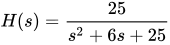
This system has no (finite) zeros and two poles:and


The pole-zero plot would be:

Notice that these two poles are complex conjugates, which is the necessary and sufficient condition to have real-valued coefficients in the differential equation representing the system.
Discrete-time systems
editIn general, a rational transfer function for a discrete-time LTI system has the form:
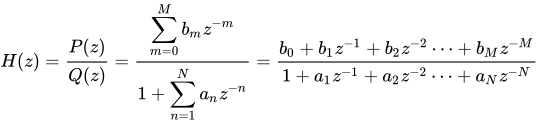
where
- is the order of the numerator polynomial,
- is the th coefficient of the numerator polynomial,
- is the order of the denominator polynomial, and
- is the th coefficient of the denominator polynomial.
Either or or both may be zero.
Poles and zeros
edit
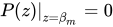

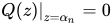
Region of convergence
editThe region of convergence (ROC) for a given discrete-time transfer function is a disk or annulus which contains no uncancelled poles. In general, the ROC is not unique, and the particular ROC in any given case depends on whether the system is causal or anti-causal.
- If the ROC includes the unit circle, then the system is bounded-input, bounded-output (BIBO) stable.
- If the ROC extends outward from the pole with the largest (but not infinite) magnitude, then the system has a right-sided impulse response. If the ROC extends outward from the pole with the largest magnitude and there is no pole at infinity, then the system is causal.
- If the ROC extends inward from the pole with the smallest (nonzero) magnitude, then the system is anti-causal.
The ROC is usually chosen to include the unit circle since it is important for most practical systems to have BIBO stability.
Example
editIf and are completely factored, their solution can be easily plotted in the z-plane. For example, given the following transfer function:


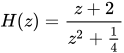
The only (finite) zero is located at: , and the two poles are located at: , where is the imaginary unit.


The pole–zero plot would be:

See also
editBibliography
edit- Haag, Michael (June 22, 2005). "Understanding Pole/Zero Plots on the Z-Plane". OpenStax CNX. Archived from the original on June 12, 2018. Retrieved June 9, 2018.
- Eric W. Weisstein. "Z-Transform". MathWorld. Retrieved January 24, 2010.
