


A Patlak plot (sometimes called Gjedde–Patlak plot, Patlak–Rutland plot, or Patlak analysis)[1][2] is a graphical analysis technique based on the compartment model that uses linear regression to identify and analyze pharmacokinetics of tracers involving irreversible uptake, such as in the case of deoxyglucose.[3][4] It is used for the evaluation of nuclear medicine imaging data after the injection of a radioopaque or radioactive tracer.
The method is model-independent because it does not depend on any specific compartmental model configuration for the tracer, and the minimal assumption is that the behavior of the tracer can be approximated by two compartments – a "central" (or reversible) compartment that is in rapid equilibrium with plasma, and a "peripheral" (or irreversible) compartment, where tracer enters without ever leaving during the time of the measurements.[1][2] The amount of tracer in the region of interest is accumulating according to the equation:

where represents time after tracer injection, is the amount of tracer in region of interest, is the concentration of tracer in plasma or blood, is the clearance determining the rate of entry into the peripheral (irreversible) compartment, and is the distribution volume of the tracer in the central compartment. The first term of the right-hand side represents tracer in the peripheral compartment, and the second term tracer in the central compartment.


By dividing both sides by , one obtains:
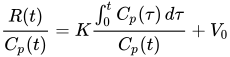
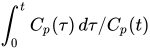
The unknown constants and can be obtained by linear regression from a graph of against .

See also
edit- Logan plot
- Positron emission tomography
- Multi-compartment model
- Binding potential
- Deconvolution
- Albert Gjedde
References
edit- ^ a b C. S. Patlak; R. G. Blasberg; J. D. Fenstermacher (March 1983). "Graphical evaluation of blood-to-brain transfer constants from multiple-time uptake data". Journal of Cerebral Blood Flow and Metabolism. 3 (1): 1–7. doi:10.1038/jcbfm.1983.1. PMID 6822610.
- ^ a b C.S. Patlak; R.G. Blasberg (April 1985). "Graphical evaluation of blood-to-brain transfer constants from multiple-time uptake data. Generalizations". Journal of Cerebral Blood Flow and Metabolism. 5 (4): 584–590. doi:10.1038/jcbfm.1985.87. PMID 4055928.
- ^ A. Gjedde (April 1981). "High- and low-affinity transport of D-glucose from blood to brain". Journal of Neurochemistry. 36 (4): 1463–1471. doi:10.1111/j.1471-4159.1981.tb00587.x. PMID 7264642.
- ^ A. Gjedde (June 1982). "Calculation of glucose phosphorylation from brain uptake of glucose analogs in vivo: A re-examination". Brain Research Reviews. 4 (2): 237–274. doi:10.1016/0165-0173(82)90018-2. PMID 7104768.
Further literature
edit- A Gjedde (1 March 1997). "Dark origins of the Patlak-Gjedde-Blasberg-Fenstermacher-Rutland -Rehling Plot". Nuclear Medicine Communications. 18 (3): 274–275. doi:10.1097/00006231-199703000-00014. ISSN 0143-3636. PMID 9106783. Wikidata Q48779416.
External links
edit- PMOD, Patlak Plot, PMOD Kinetic Modeling Tool (PKIN).
- Gjedde–Patlak plot, Turku PET Centre.

