In mathematics, particularly p-adic analysis, the p-adic exponential function is a p-adic analogue of the usual exponential function on the complex numbers. As in the complex case, it has an inverse function, named the p-adic logarithm.
Definition
editThe usual exponential function on C is defined by the infinite series
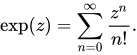
Entirely analogously, one defines the exponential function on Cp, the completion of the algebraic closure of Qp, by
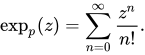
However, unlike exp which converges on all of C, expp only converges on the disc
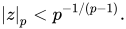
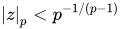
This is because p-adic series converge if and only if the summands tend to zero, and since the n! in the denominator of each summand tends to make them large p-adically, a small value of z is needed in the numerator. It follows from Legendre's formula that if then tends to , p-adically.


Although the p-adic exponential is sometimes denoted ex, the number e itself has no p-adic analogue. This is because the power series expp(x) does not converge at x = 1. It is possible to choose a number e to be a p-th root of expp(p) for p ≠ 2,[a] but there are multiple such roots and there is no canonical choice among them.[1]
p-adic logarithm function
editThe power series
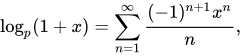
converges for x in Cp satisfying |x|p < 1 and so defines the p-adic logarithm function logp(z) for |z − 1|p < 1 satisfying the usual property logp(zw) = logpz + logpw. The function logp can be extended to all of C×
p (the set of nonzero elements of Cp) by imposing that it continues to satisfy this last property and setting logp(p) = 0. Specifically, every element w of C×
p can be written as w = pr·ζ·z with r a rational number, ζ a root of unity, and |z − 1|p < 1,[2] in which case logp(w) = logp(z).[b] This function on C×
p is sometimes called the Iwasawa logarithm to emphasize the choice of logp(p) = 0. In fact, there is an extension of the logarithm from |z − 1|p < 1 to all of C×
p for each choice of logp(p) in Cp.[3]
Properties
editIf z and w are both in the radius of convergence for expp, then their sum is too and we have the usual addition formula: expp(z + w) = expp(z)expp(w).
Similarly if z and w are nonzero elements of Cp then logp(zw) = logpz + logpw.
For z in the domain of expp, we have expp(logp(1+z)) = 1+z and logp(expp(z)) = z.
The roots of the Iwasawa logarithm logp(z) are exactly the elements of Cp of the form pr·ζ where r is a rational number and ζ is a root of unity.[4]
Note that there is no analogue in Cp of Euler's identity, e2πi = 1. This is a corollary of Strassmann's theorem.
Another major difference to the situation in C is that the domain of convergence of expp is much smaller than that of logp. A modified exponential function — the Artin–Hasse exponential — can be used instead which converges on |z|p < 1.
Notes
editReferences
editCitations
edit- ^ Robert 2000, p. 252
- ^ Cohen 2007, Proposition 4.4.44
- ^ Cohen 2007, §4.4.11
- ^ Cohen 2007, Proposition 4.4.45
List of references
edit- Chapter 12 of Cassels, J. W. S. (1986). Local fields. London Mathematical Society Student Texts. Cambridge University Press. ISBN 0-521-31525-5.
- Cohen, Henri (2007), Number theory, Volume I: Tools and Diophantine equations, Graduate Texts in Mathematics, vol. 239, New York: Springer, doi:10.1007/978-0-387-49923-9, ISBN 978-0-387-49922-2, MR 2312337
- Robert, Alain M. (2000), A Course in p-adic Analysis, Springer, ISBN 0-387-98669-3
