This article is about coded aperture masks. For other uses, see Mura.
A modified uniformly redundant array (MURA) is a type of mask used in coded aperture imaging. They were first proposed by Gottesman and Fenimore in 1989.[1]
Mathematical Construction of MURAs
edit
MURAs can be generated in any length L that is prime and of the form
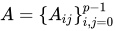
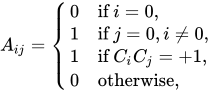
the first five such values being . The binary sequence of a linear MURA is given by , where
These linear MURA arrays can also be arranged to form hexagonal MURA arrays. One may note that if and , a uniformly redundant array(URA) is a generated.
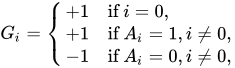
As with any mask in coded aperture imaging, an inverse sequence must also be constructed. In the MURA case, this inverse G can be constructed easily given the original coding pattern A:
Rectangular MURA arrays are constructed in a slightly different manner, letting , where
and
A rectangular MURA mask of size 101
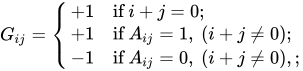
The corresponding decoding function G is constructed as follows:
transferase (MurA), an enzyme Mura (cicada), a genus of cicadas Modified Uniformly Redundant Array (MURA), a type of mask used in coded aperture imaging ND Mura
to run applications and operating systems, and up to 32 TB usable redundant array of independent memory (RAIM), some of which can be configured as Virtual
for arbitrarily sized disk arrays while reducing the overhead to clients when recovering from disk failures. It uniformly spreads or declusters user data
the operating system (often involving a volume manager, RAID controller, array manager, or suitable device driver); and the management of data and files
representation of the EA is called redundant. In nature, this is termed a degenerate genetic code. In the case of a redundant representation, neutral mutations
collectively. array data structure A data structure consisting of a collection of elements (values or variables), each identified by at least one array index
of taking an ordinary algorithm (e.g., Cooley–Tukey) and removing the redundant parts of the computation, saving roughly a factor of two in time and memory