Truncation errors in numerical integration are of two kinds:
- local truncation errors – the error caused by one iteration, and
- global truncation errors – the cumulative error caused by many iterations.
Definitions
editSuppose we have a continuous differential equation

and we wish to compute an approximation of the true solution at discrete time steps . For simplicity, assume the time steps are equally spaced:




Suppose we compute the sequence with a one-step method of the form

The function is called the increment function, and can be interpreted as an estimate of the slope .

Local truncation error
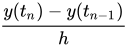
editThe local truncation error is the error that our increment function, , causes during a single iteration, assuming perfect knowledge of the true solution at the previous iteration.

More formally, the local truncation error, , at step is computed from the difference between the left- and the right-hand side of the equation for the increment :



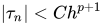
The numerical method is consistent if the local truncation error is (this means that for every there exists an such that for all ; see little-o notation). If the increment function is continuous, then the method is consistent if, and only if, .[3]



Furthermore, we say that the numerical method has order if for any sufficiently smooth solution of the initial value problem, the local truncation error is (meaning that there exist constants and such that for all ).[4]


Global truncation error
editThe global truncation error is the accumulation of the local truncation error over all of the iterations, assuming perfect knowledge of the true solution at the initial time step.[citation needed]
More formally, the global truncation error, , at time is defined by:



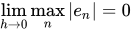
The numerical method is convergent if global truncation error goes to zero as the step size goes to zero; in other words, the numerical solution converges to the exact solution: .[6]
Relationship between local and global truncation errors
editSometimes it is possible to calculate an upper bound on the global truncation error, if we already know the local truncation error. This requires our increment function be sufficiently well-behaved.
The global truncation error satisfies the recurrence relation:

This follows immediately from the definitions. Now assume that the increment function is Lipschitz continuous in the second argument, that is, there exists a constant such that for all and and , we have:



Then the global error satisfies the bound

It follows from the above bound for the global error that if the function in the differential equation is continuous in the first argument and Lipschitz continuous in the second argument (the condition from the Picard–Lindelöf theorem), and the increment function is continuous in all arguments and Lipschitz continuous in the second argument, then the global error tends to zero as the step size approaches zero (in other words, the numerical method converges to the exact solution).[8]


Extension to linear multistep methods
editNow consider a linear multistep method, given by the formula

Thus, the next value for the numerical solution is computed according to

The next iterate of a linear multistep method depends on the previous s iterates. Thus, in the definition for the local truncation error, it is now assumed that the previous s iterates all correspond to the exact solution:

Again, the method is consistent if and it has order p if . The definition of the global truncation error is also unchanged.

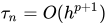
The relation between local and global truncation errors is slightly different from in the simpler setting of one-step methods. For linear multistep methods, an additional concept called zero-stability is needed to explain the relation between local and global truncation errors. Linear multistep methods that satisfy the condition of zero-stability have the same relation between local and global errors as one-step methods. In other words, if a linear multistep method is zero-stable and consistent, then it converges. And if a linear multistep method is zero-stable and has local error , then its global error satisfies .[10]

See also
editNotes
edit- ^ Gupta, G. K.; Sacks-Davis, R.; Tischer, P. E. (March 1985). "A review of recent developments in solving ODEs". Computing Surveys. 17 (1): 5–47. CiteSeerX 10.1.1.85.783. doi:10.1145/4078.4079.
- ^ Süli & Mayers 2003, p. 317, calls the truncation error.
- ^ Süli & Mayers 2003, pp. 321 & 322
- ^ Iserles 1996, p. 8; Süli & Mayers 2003, p. 323
- ^ Süli & Mayers 2003, p. 317
- ^ Iserles 1996, p. 5
- ^ Süli & Mayers 2003, p. 318
- ^ Süli & Mayers 2003, p. 322
- ^ Süli & Mayers 2003, p. 337, uses a different definition, dividing this by essentially by h
- ^ Süli & Mayers 2003, p. 340

References
edit- Iserles, Arieh (1996), A First Course in the Numerical Analysis of Differential Equations, Cambridge University Press, Bibcode:1996fcna.book.....I, ISBN 978-0-521-55655-2.
- Süli, Endre; Mayers, David (2003), An Introduction to Numerical Analysis, Cambridge University Press, ISBN 0521007941.
