


In the mathematical field of geometric group theory, a length function is a function that assigns a number to each element of a group.
Definition
editA length function L : G → R+ on a group G is a function satisfying:[1][2][3]
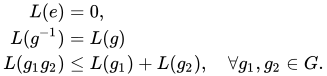
Compare with the axioms for a metric and a filtered algebra.
Word metric
editAn important example of a length is the word metric: given a presentation of a group by generators and relations, the length of an element is the length of the shortest word expressing it.
Coxeter groups (including the symmetric group) have combinatorially important length functions, using the simple reflections as generators (thus each simple reflection has length 1). See also: length of a Weyl group element.
A longest element of a Coxeter group is both important and unique up to conjugation (up to different choice of simple reflections).
Properties
editA group with a length function does not form a filtered group, meaning that the sublevel sets do not form subgroups in general.

However, the group algebra of a group with a length functions forms a filtered algebra: the axiom corresponds to the filtration axiom.

References
edit- ^ Lyndon, Roger C. (1963), "Length functions in groups", Mathematica Scandinavica, 12: 209–234, doi:10.7146/math.scand.a-10684, JSTOR 24489388, MR 0163947
- ^ Harrison, Nancy (1972), "Real length functions in groups", Transactions of the American Mathematical Society, 174: 77–106, doi:10.2307/1996098, MR 0308283
- ^ Chiswell, I. M. (1976), "Abstract length functions in groups", Mathematical Proceedings of the Cambridge Philosophical Society, 80 (3): 451–463, doi:10.1017/S0305004100053093, MR 0427480
This article incorporates material from Length function on PlanetMath, which is licensed under the Creative Commons Attribution/Share-Alike License.

