In mathematics, a Jackson q -Bessel function (or basic Bessel function ) is one of the three q -analogsBessel function introduced by Jackson (1906a , 1906b , 1905a , 1905b ). The third Jackson q -Bessel function is the same as the Hahn–Exton q -Bessel function .
Definition
edit
The three Jackson q -Bessel functions are given in terms of the q -Pochhammer symbolbasic hypergeometric function
ϕ
{\displaystyle \phi }
J
ν
(
1
)
(
x
;
q
)
=
(
q
ν
+
1
;
q
)
∞
(
q
;
q
)
∞
(
x
/
2
)
ν
2
ϕ
1
(
0
,
0
;
q
ν
+
1
;
q
,
−
x
2
/
4
)
,
|
x
|
<
2
,
{\displaystyle J_{\nu }^{(1)}(x;q)={\frac {(q^{\nu +1};q)_{\infty }}{(q;q)_{\infty }}}(x/2)^{\nu }{}_{2}\phi _{1}(0,0;q^{\nu +1};q,-x^{2}/4),\quad |x|<2,}
J
ν
(
2
)
(
x
;
q
)
=
(
q
ν
+
1
;
q
)
∞
(
q
;
q
)
∞
(
x
/
2
)
ν
0
ϕ
1
(
;
q
ν
+
1
;
q
,
−
x
2
q
ν
+
1
/
4
)
,
x
∈
C
,
{\displaystyle J_{\nu }^{(2)}(x;q)={\frac {(q^{\nu +1};q)_{\infty }}{(q;q)_{\infty }}}(x/2)^{\nu }{}_{0}\phi _{1}(;q^{\nu +1};q,-x^{2}q^{\nu +1}/4),\quad x\in \mathbb {C} ,}
J
ν
(
3
)
(
x
;
q
)
=
(
q
ν
+
1
;
q
)
∞
(
q
;
q
)
∞
(
x
/
2
)
ν
1
ϕ
1
(
0
;
q
ν
+
1
;
q
,
q
x
2
/
4
)
,
x
∈
C
.
{\displaystyle J_{\nu }^{(3)}(x;q)={\frac {(q^{\nu +1};q)_{\infty }}{(q;q)_{\infty }}}(x/2)^{\nu }{}_{1}\phi _{1}(0;q^{\nu +1};q,qx^{2}/4),\quad x\in \mathbb {C} .}
They can be reduced to the Bessel function by the continuous limit:
lim
q
→
1
J
ν
(
k
)
(
x
(
1
−
q
)
;
q
)
=
J
ν
(
x
)
,
k
=
1
,
2
,
3.
{\displaystyle \lim _{q\to 1}J_{\nu }^{(k)}(x(1-q);q)=J_{\nu }(x),\ k=1,2,3.}
There is a connection formula between the first and second Jackson q -Bessel function (Gasper & Rahman (2004) ):
J
ν
(
2
)
(
x
;
q
)
=
(
−
x
2
/
4
;
q
)
∞
J
ν
(
1
)
(
x
;
q
)
,
|
x
|
<
2.
{\displaystyle J_{\nu }^{(2)}(x;q)=(-x^{2}/4;q)_{\infty }J_{\nu }^{(1)}(x;q),\ |x|<2.}
For integer order, the q -Bessel functions satisfy
J
n
(
k
)
(
−
x
;
q
)
=
(
−
1
)
n
J
n
(
k
)
(
x
;
q
)
,
n
∈
Z
,
k
=
1
,
2
,
3.
{\displaystyle J_{n}^{(k)}(-x;q)=(-1)^{n}J_{n}^{(k)}(x;q),\ n\in \mathbb {Z} ,\ k=1,2,3.}
Properties
edit
Negative Integer Order
edit
By using the relations (Gasper & Rahman (2004) ):
(
q
m
+
1
;
q
)
∞
=
(
q
m
+
n
+
1
;
q
)
∞
(
q
m
+
1
;
q
)
n
,
{\displaystyle (q^{m+1};q)_{\infty }=(q^{m+n+1};q)_{\infty }(q^{m+1};q)_{n},}
(
q
;
q
)
m
+
n
=
(
q
;
q
)
m
(
q
m
+
1
;
q
)
n
,
m
,
n
∈
Z
,
{\displaystyle (q;q)_{m+n}=(q;q)_{m}(q^{m+1};q)_{n},\ m,n\in \mathbb {Z} ,}
we obtain
J
−
n
(
k
)
(
x
;
q
)
=
(
−
1
)
n
J
n
(
k
)
(
x
;
q
)
,
k
=
1
,
2.
{\displaystyle J_{-n}^{(k)}(x;q)=(-1)^{n}J_{n}^{(k)}(x;q),\ k=1,2.}
Zeros
edit
Hahn mentioned that
J
ν
(
2
)
(
x
;
q
)
{\displaystyle J_{\nu }^{(2)}(x;q)}
Hahn (1949 )). Ismail proved that for
ν
>
−
1
{\displaystyle \nu >-1}
J
ν
(
2
)
(
x
;
q
)
{\displaystyle J_{\nu }^{(2)}(x;q)}
Ismail (1982 )).
Ratio of q -Bessel Functions
edit
The function
−
i
x
−
1
/
2
J
ν
+
1
(
2
)
(
i
x
1
/
2
;
q
)
/
J
ν
(
2
)
(
i
x
1
/
2
;
q
)
{\displaystyle -ix^{-1/2}J_{\nu +1}^{(2)}(ix^{1/2};q)/J_{\nu }^{(2)}(ix^{1/2};q)}
completely monotonic function (Ismail (1982 )).
Recurrence Relations
edit
The first and second Jackson q -Bessel function have the following recurrence relations (see Ismail (1982) and Gasper & Rahman (2004) ):
q
ν
J
ν
+
1
(
k
)
(
x
;
q
)
=
2
(
1
−
q
ν
)
x
J
ν
(
k
)
(
x
;
q
)
−
J
ν
−
1
(
k
)
(
x
;
q
)
,
k
=
1
,
2.
{\displaystyle q^{\nu }J_{\nu +1}^{(k)}(x;q)={\frac {2(1-q^{\nu })}{x}}J_{\nu }^{(k)}(x;q)-J_{\nu -1}^{(k)}(x;q),\ k=1,2.}
J
ν
(
1
)
(
x
q
;
q
)
=
q
±
ν
/
2
(
J
ν
(
1
)
(
x
;
q
)
±
x
2
J
ν
±
1
(
1
)
(
x
;
q
)
)
.
{\displaystyle J_{\nu }^{(1)}(x{\sqrt {q}};q)=q^{\pm \nu /2}\left(J_{\nu }^{(1)}(x;q)\pm {\frac {x}{2}}J_{\nu \pm 1}^{(1)}(x;q)\right).}
Inequalities
edit
When
ν
>
−
1
{\displaystyle \nu >-1}
q -Bessel function satisfies:
|
J
ν
(
2
)
(
z
;
q
)
|
≤
(
−
q
;
q
)
∞
(
q
;
q
)
∞
(
|
z
|
2
)
ν
exp
{
log
(
|
z
|
2
q
ν
/
4
)
2
log
q
}
.
{\displaystyle \left|J_{\nu }^{(2)}(z;q)\right|\leq {\frac {(-{\sqrt {q}};q)_{\infty }}{(q;q)_{\infty }}}\left({\frac {|z|}{2}}\right)^{\nu }\exp \left\{{\frac {\log \left(|z|^{2}q^{\nu }/4\right)}{2\log q}}\right\}.}
2006 ).)
For
n
∈
Z
{\displaystyle n\in \mathbb {Z} }
|
J
n
(
2
)
(
z
;
q
)
|
≤
(
−
q
n
+
1
;
q
)
∞
(
q
;
q
)
∞
(
|
z
|
2
)
n
(
−
|
z
|
2
;
q
)
∞
.
{\displaystyle \left|J_{n}^{(2)}(z;q)\right|\leq {\frac {(-q^{n+1};q)_{\infty }}{(q;q)_{\infty }}}\left({\frac {|z|}{2}}\right)^{n}(-|z|^{2};q)_{\infty }.}
1993 ).)
Generating Function
edit
The following formulas are the q -analog of the generating function for the Bessel function (see Gasper & Rahman (2004) ):
∑
n
=
−
∞
∞
t
n
J
n
(
2
)
(
x
;
q
)
=
(
−
x
2
/
4
;
q
)
∞
e
q
(
x
t
/
2
)
e
q
(
−
x
/
2
t
)
,
{\displaystyle \sum _{n=-\infty }^{\infty }t^{n}J_{n}^{(2)}(x;q)=(-x^{2}/4;q)_{\infty }e_{q}(xt/2)e_{q}(-x/2t),}
∑
n
=
−
∞
∞
t
n
J
n
(
3
)
(
x
;
q
)
=
e
q
(
x
t
/
2
)
E
q
(
−
q
x
/
2
t
)
.
{\displaystyle \sum _{n=-\infty }^{\infty }t^{n}J_{n}^{(3)}(x;q)=e_{q}(xt/2)E_{q}(-qx/2t).}
e
q
{\displaystyle e_{q}}
q -exponential
Alternative Representations
edit
Integral Representations
edit
The second Jackson q -Bessel function has the following integral representations (see Rahman (1987) and Ismail & Zhang (2018a) ):
J
ν
(
2
)
(
x
;
q
)
=
(
q
2
ν
;
q
)
∞
2
π
(
q
ν
;
q
)
∞
(
x
/
2
)
ν
⋅
∫
0
π
(
e
2
i
θ
,
e
−
2
i
θ
,
−
i
x
q
(
ν
+
1
)
/
2
2
e
i
θ
,
−
i
x
q
(
ν
+
1
)
/
2
2
e
−
i
θ
;
q
)
∞
(
e
2
i
θ
q
ν
,
e
−
2
i
θ
q
ν
;
q
)
∞
d
θ
,
{\displaystyle J_{\nu }^{(2)}(x;q)={\frac {(q^{2\nu };q)_{\infty }}{2\pi (q^{\nu };q)_{\infty }}}(x/2)^{\nu }\cdot \int _{0}^{\pi }{\frac {\left(e^{2i\theta },e^{-2i\theta },-{\frac {ixq^{(\nu +1)/2}}{2}}e^{i\theta },-{\frac {ixq^{(\nu +1)/2}}{2}}e^{-i\theta };q\right)_{\infty }}{(e^{2i\theta }q^{\nu },e^{-2i\theta }q^{\nu };q)_{\infty }}}\,d\theta ,}
(
a
1
,
a
2
,
⋯
,
a
n
;
q
)
∞
:=
(
a
1
;
q
)
∞
(
a
2
;
q
)
∞
⋯
(
a
n
;
q
)
∞
,
ℜ
ν
>
0
,
{\displaystyle (a_{1},a_{2},\cdots ,a_{n};q)_{\infty }:=(a_{1};q)_{\infty }(a_{2};q)_{\infty }\cdots (a_{n};q)_{\infty },\ \Re \nu >0,}
where
(
a
;
q
)
∞
{\displaystyle (a;q)_{\infty }}
q -Pochhammer symbol
q
→
1
{\displaystyle q\to 1}
J
ν
(
2
)
(
z
;
q
)
=
(
z
/
2
)
ν
2
π
log
q
−
1
∫
−
∞
∞
(
q
ν
+
1
/
2
z
2
e
i
x
4
;
q
)
∞
exp
(
x
2
log
q
2
)
(
q
,
−
q
ν
+
1
/
2
e
i
x
;
q
)
∞
d
x
.
{\displaystyle J_{\nu }^{(2)}(z;q)={\frac {(z/2)^{\nu }}{\sqrt {2\pi \log q^{-1}}}}\int _{-\infty }^{\infty }{\frac {\left({\frac {q^{\nu +1/2}z^{2}e^{ix}}{4}};q\right)_{\infty }\exp \left({\frac {x^{2}}{\log q^{2}}}\right)}{(q,-q^{\nu +1/2}e^{ix};q)_{\infty }}}\,dx.}
Hypergeometric Representations
edit
The second Jackson q -Bessel function has the following hypergeometric representations (see Koelink (1993 ), Chen, Ismail , and Muttalib (1994 )):
J
ν
(
2
)
(
x
;
q
)
=
(
x
/
2
)
ν
(
q
;
q
)
∞
1
ϕ
1
(
−
x
2
/
4
;
0
;
q
,
q
ν
+
1
)
,
{\displaystyle J_{\nu }^{(2)}(x;q)={\frac {(x/2)^{\nu }}{(q;q)_{\infty }}}\ _{1}\phi _{1}(-x^{2}/4;0;q,q^{\nu +1}),}
J
ν
(
2
)
(
x
;
q
)
=
(
x
/
2
)
ν
(
q
;
q
)
∞
2
(
q
;
q
)
∞
[
f
(
x
/
2
,
q
(
ν
+
1
/
2
)
/
2
;
q
)
+
f
(
−
x
/
2
,
q
(
ν
+
1
/
2
)
/
2
;
q
)
]
,
f
(
x
,
a
;
q
)
:=
(
i
a
x
;
q
)
∞
3
ϕ
2
(
a
,
−
a
,
0
−
q
,
i
a
x
;
q
,
q
)
.
{\displaystyle J_{\nu }^{(2)}(x;q)={\frac {(x/2)^{\nu }({\sqrt {q}};q)_{\infty }}{2(q;q)_{\infty }}}[f(x/2,q^{(\nu +1/2)/2};q)+f(-x/2,q^{(\nu +1/2)/2};q)],\ f(x,a;q):=(iax;{\sqrt {q}})_{\infty }\ _{3}\phi _{2}\left({\begin{matrix}a,&-a,&0\\-{\sqrt {q}},&iax\end{matrix}};{\sqrt {q}},{\sqrt {q}}\right).}
An asymptotic expansion can be obtained as an immediate consequence of the second formula.
For other hypergeometric representations, see Rahman (1987) .
Modified q -Bessel Functions
edit
The q -analog of the modified Bessel functions are defined with the Jackson q -Bessel function (Ismail (1981) and Olshanetsky & Rogov (1995) ):
I
ν
(
j
)
(
x
;
q
)
=
e
i
ν
π
/
2
J
ν
(
j
)
(
x
;
q
)
,
j
=
1
,
2.
{\displaystyle I_{\nu }^{(j)}(x;q)=e^{i\nu \pi /2}J_{\nu }^{(j)}(x;q),\ j=1,2.}
K
ν
(
j
)
(
x
;
q
)
=
π
2
sin
(
π
ν
)
{
I
−
ν
(
j
)
(
x
;
q
)
−
I
ν
(
j
)
(
x
;
q
)
}
,
j
=
1
,
2
,
ν
∈
C
−
Z
,
{\displaystyle K_{\nu }^{(j)}(x;q)={\frac {\pi }{2\sin(\pi \nu )}}\left\{I_{-\nu }^{(j)}(x;q)-I_{\nu }^{(j)}(x;q)\right\},\ j=1,2,\ \nu \in \mathbb {C} -\mathbb {Z} ,}
K
n
(
j
)
(
x
;
q
)
=
lim
ν
→
n
K
ν
(
j
)
(
x
;
q
)
,
n
∈
Z
.
{\displaystyle K_{n}^{(j)}(x;q)=\lim _{\nu \to n}K_{\nu }^{(j)}(x;q),\ n\in \mathbb {Z} .}
There is a connection formula between the modified q-Bessel functions:
I
ν
(
2
)
(
x
;
q
)
=
(
−
x
2
/
4
;
q
)
∞
I
ν
(
1
)
(
x
;
q
)
.
{\displaystyle I_{\nu }^{(2)}(x;q)=(-x^{2}/4;q)_{\infty }I_{\nu }^{(1)}(x;q).}
For statistical applications, see Kemp (1997) .
Recurrence Relations
edit
By the recurrence relation of Jackson q -Bessel functions and the definition of modified q -Bessel functions, the following recurrence relation can be obtained (
K
ν
(
j
)
(
x
;
q
)
{\displaystyle K_{\nu }^{(j)}(x;q)}
Ismail (1981) ):
q
ν
I
ν
+
1
(
j
)
(
x
;
q
)
=
2
z
(
1
−
q
ν
)
I
ν
(
j
)
(
x
;
q
)
+
I
ν
−
1
(
j
)
(
x
;
q
)
,
j
=
1
,
2.
{\displaystyle q^{\nu }I_{\nu +1}^{(j)}(x;q)={\frac {2}{z}}(1-q^{\nu })I_{\nu }^{(j)}(x;q)+I_{\nu -1}^{(j)}(x;q),\ j=1,2.}
For other recurrence relations, see Olshanetsky & Rogov (1995) .
Continued Fraction Representation
edit
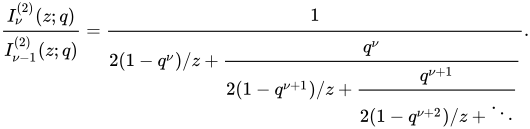
The ratio of modified q -Bessel functions form a continued fraction (Ismail (1981) ):
I
ν
(
2
)
(
z
;
q
)
I
ν
−
1
(
2
)
(
z
;
q
)
=
1
2
(
1
−
q
ν
)
/
z
+
q
ν
2
(
1
−
q
ν
+
1
)
/
z
+
q
ν
+
1
2
(
1
−
q
ν
+
2
)
/
z
+
⋱
.
{\displaystyle {\frac {I_{\nu }^{(2)}(z;q)}{I_{\nu -1}^{(2)}(z;q)}}={\cfrac {1}{2(1-q^{\nu })/z+{\cfrac {q^{\nu }}{2(1-q^{\nu +1})/z+{\cfrac {q^{\nu +1}}{2(1-q^{\nu +2})/z+\ddots }}}}}}.}
Alternative Representations
edit
Hypergeometric Representations
edit
The function
I
ν
(
2
)
(
z
;
q
)
{\displaystyle I_{\nu }^{(2)}(z;q)}
Ismail & Zhang (2018b) ):
I
ν
(
2
)
(
z
;
q
)
=
(
z
/
2
)
ν
(
q
,
q
)
∞
1
ϕ
1
(
z
2
/
4
;
0
;
q
,
q
ν
+
1
)
.
{\displaystyle I_{\nu }^{(2)}(z;q)={\frac {(z/2)^{\nu }}{(q,q)_{\infty }}}{}_{1}\phi _{1}(z^{2}/4;0;q,q^{\nu +1}).}
Integral Representations
edit
The modified q -Bessel functions have the following integral representations (Ismail (1981) ):
I
ν
(
2
)
(
z
;
q
)
=
(
z
2
/
4
;
q
)
∞
(
1
π
∫
0
π
cos
ν
θ
d
θ
(
e
i
θ
z
/
2
;
q
)
∞
(
e
−
i
θ
z
/
2
;
q
)
∞
−
sin
ν
π
π
∫
0
∞
e
−
ν
t
d
t
(
−
e
t
z
/
2
;
q
)
∞
(
−
e
−
t
z
/
2
;
q
)
∞
)
,
{\displaystyle I_{\nu }^{(2)}(z;q)=\left(z^{2}/4;q\right)_{\infty }\left({\frac {1}{\pi }}\int _{0}^{\pi }{\frac {\cos \nu \theta \,d\theta }{\left(e^{i\theta }z/2;q\right)_{\infty }\left(e^{-i\theta }z/2;q\right)_{\infty }}}-{\frac {\sin \nu \pi }{\pi }}\int _{0}^{\infty }{\frac {e^{-\nu t}\,dt}{\left(-e^{t}z/2;q\right)_{\infty }\left(-e^{-t}z/2;q\right)_{\infty }}}\right),}
K
ν
(
1
)
(
z
;
q
)
=
1
2
∫
0
∞
e
−
ν
t
d
t
(
−
e
t
/
2
z
/
2
;
q
)
∞
(
−
e
−
t
/
2
z
/
2
;
q
)
∞
,
|
arg
z
|
<
π
/
2
,
{\displaystyle K_{\nu }^{(1)}(z;q)={\frac {1}{2}}\int _{0}^{\infty }{\frac {e^{-\nu t}\,dt}{\left(-e^{t/2}z/2;q\right)_{\infty }\left(-e^{-t/2}z/2;q\right)_{\infty }}},\ |\arg z|<\pi /2,}
K
ν
(
1
)
(
z
;
q
)
=
∫
0
∞
cosh
ν
d
t
(
−
e
t
/
2
z
/
2
;
q
)
∞
(
−
e
−
t
/
2
z
/
2
;
q
)
∞
.
{\displaystyle K_{\nu }^{(1)}(z;q)=\int _{0}^{\infty }{\frac {\cosh \nu \,dt}{\left(-e^{t/2}z/2;q\right)_{\infty }\left(-e^{-t/2}z/2;q\right)_{\infty }}}.}
See also
edit
References
edit
Chen, Yang; Ismail, Mourad E. H.; Muttalib, K.A. (1994), "Asymptotics of basic Bessel functions and q -Laguerre polynomials", Journal of Computational and Applied Mathematics , 54 (3): 263– 272, doi :10.1016/0377-0427(92)00128-v Gasper, G.; Rahman, M. (2004), Basic hypergeometric series , Encyclopedia of Mathematics and its Applications, vol. 96 (2nd ed.), Cambridge University Press , ISBN 978-0-521-83357-8 MR 2128719 Hahn, Wolfgang (1949), "Über Orthogonalpolynome, die q-Differenzengleichungen genügen", Mathematische Nachrichten 2 (1– 2): 4– 34, doi :10.1002/mana.19490020103 , ISSN 0025-584X , MR 0030647 Ismail, Mourad E. H. (1981), "The Basic Bessel Functions and Polynomials", SIAM Journal on Mathematical Analysis , 12 (3): 454– 468, doi :10.1137/0512038 Ismail, Mourad E. H. (1982), "The zeros of basic Bessel functions, the functions J ν+ax (x ), and associated orthogonal polynomials", Journal of Mathematical Analysis and Applications 86 (1): 1– 19, doi :10.1016/0022-247X(82)90248-7 , ISSN 0022-247X , MR 0649849 Ismail, M. E. H.; Zhang, R. (2018a), "Integral and Series Representations of q -Polynomials and Functions: Part I", Analysis and Applications , 16 (2): 209– 281, arXiv :1604.08441 doi :10.1142/S0219530517500129 , S2CID 119142457 Ismail, M. E. H.; Zhang, R. (2018b), "q -Bessel Functions and Rogers-Ramanujan Type Identities", Proceedings of the American Mathematical Society , 146 (9): 3633– 3646, arXiv :1508.06861 doi :10.1090/proc/13078 , S2CID 119721248 Jackson, F. H. (1906a), "I.—On generalized functions of Legendre and Bessel", Transactions of the Royal Society of Edinburgh , 41 (1): 1– 28, doi :10.1017/S0080456800080017 Jackson, F. H. (1906b), "VI.—Theorems relating to a generalization of the Bessel function" , Transactions of the Royal Society of Edinburgh , 41 (1): 105– 118, doi :10.1017/S0080456800080078 Jackson, F. H. (1906c), "XVII.—Theorems relating to a generalization of Bessel's function" , Transactions of the Royal Society of Edinburgh , 41 (2): 399– 408, doi :10.1017/s0080456800034475 , JFM 36.0513.02 Jackson, F. H. (1905a), "The Application of Basic Numbers to Bessel's and Legendre's Functions" , Proceedings of the London Mathematical Society , 2, 2 (1): 192– 220, doi :10.1112/plms/s2-2.1.192 Jackson, F. H. (1905b), "The Application of Basic Numbers to Bessel's and Legendre's Functions (Second paper)" , Proceedings of the London Mathematical Society , 2, 3 (1): 1– 23, doi :10.1112/plms/s2-3.1.1 Kemp, A. W. (1997), "On Modified q-Bessel Functions and Some Statistical Applications", in N. Balakrishnan (ed.), Advances in Combinatorial Methods and Applications to Probability and Statistics , pp. 451– 463, doi :10.1007/978-1-4612-4140-9_27 , ISBN 978-1-4612-4140-9 S2CID 124998083 Koelink, H. T. (1993), "Hansen-Lommel Orthogonality Relations for Jackson's q -Bessel Functions", Journal of Mathematical Analysis and Applications 175 (2): 425– 437, doi :10.1006/jmaa.1993.1181 Olshanetsky, M. A.; Rogov, V. B. (1995), "The Modified q -Bessel Functions and the q -Bessel-Macdonald Functions", arXiv :q-alg/9509013 Rahman, M. (1987), "An Integral Representation and Some Transformation Properties of q -Bessel Functions", Journal of Mathematical Analysis and Applications 125 : 58– 71, doi :10.1016/0022-247x(87)90164-8 Zhang, R. (2006), "Plancherel-Rotach Asymptotics for q -Series", arXiv :math/0612216 


























![{\displaystyle J_{\nu }^{(2)}(x;q)={\frac {(x/2)^{\nu }({\sqrt {q}};q)_{\infty }}{2(q;q)_{\infty }}}[f(x/2,q^{(\nu +1/2)/2};q)+f(-x/2,q^{(\nu +1/2)/2};q)],\ f(x,a;q):=(iax;{\sqrt {q}})_{\infty }\ _{3}\phi _{2}\left({\begin{matrix}a,&-a,&0\\-{\sqrt {q}},&iax\end{matrix}};{\sqrt {q}},{\sqrt {q}}\right).}](https://wikimedia.org/api/rest_v1/media/math/render/svg/17438ed54797c32a49c6463065678d5e9bd06548 "{\displaystyle J_{\nu }^{(2)}(x;q)={\frac {(x/2)^{\nu }({\sqrt {q}};q)_{\infty }}{2(q;q)_{\infty }}}[f(x/2,q^{(\nu +1/2)/2};q)+f(-x/2,q^{(\nu +1/2)/2};q)],\ f(x,a;q):=(iax;{\sqrt {q}})_{\infty }\ _{3}\phi _{2}\left({\begin{matrix}a,&-a,&0\\-{\sqrt {q}},&iax\end{matrix}};{\sqrt {q}},{\sqrt {q}}\right).}")