In mathematical analysis, the initial value theorem is a theorem used to relate frequency domain expressions to the time domain behavior as time approaches zero.[1]
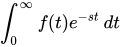
Let

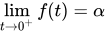
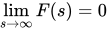
be the (one-sided) Laplace transform of ƒ(t). If is bounded on (or if just ) and exists then the initial value theorem says[2]




Proofs
editProof using dominated convergence theorem and assuming that function is bounded
editSuppose first that is bounded, i.e. . A change of variable in the integral shows that
- .
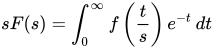
Since is bounded, the Dominated Convergence Theorem implies that

Proof using elementary calculus and assuming that function is bounded
editOf course we don't really need DCT here, one can give a very simple proof using only elementary calculus:
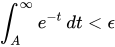
Start by choosing so that , and then note that uniformly for .

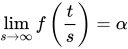
![{\displaystyle t\in (0,A]}](https://wikimedia.org/api/rest_v1/media/math/render/svg/efa1a6bb7eb5241e921b9ce0532d7c344bdc963a "{\displaystyle t\in (0,A]}")
Generalizing to non-bounded functions that have exponential order
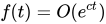
editThe theorem assuming just that follows from the theorem for bounded :
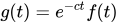
Define . Then is bounded, so we've shown that . But and , so

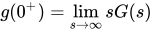
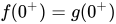


since .
See also
editNotes
edit- ^ Fourier and Laplace transforms. R. J. Beerends. Cambridge: Cambridge University Press. 2003. ISBN 978-0-511-67510-2. OCLC 593333940.
{{cite book}}: CS1 maint: others (link) - ^ Robert H. Cannon, Dynamics of Physical Systems, Courier Dover Publications, 2003, page 567.
 | This mathematical analysis–related article is a stub. You can help Wikipedia by adding missing information. |
