In the study of dynamical systems, a hyperbolic equilibrium point or hyperbolic fixed point is a fixed point that does not have any center manifolds. Near a hyperbolic point the orbits of a two-dimensional, non-dissipative system resemble hyperbolas. This fails to hold in general. Strogatz notes that "hyperbolic is an unfortunate name—it sounds like it should mean 'saddle point'—but it has become standard."[1] Several properties hold about a neighborhood of a hyperbolic point, notably[2]

- A stable manifold and an unstable manifold exist,
- Shadowing occurs,
- The dynamics on the invariant set can be represented via symbolic dynamics,
- A natural measure can be defined,
- The system is structurally stable.
Maps
editIf is a C1 map and p is a fixed point then p is said to be a hyperbolic fixed point when the Jacobian matrix has no eigenvalues on the complex unit circle.


One example of a map whose only fixed point is hyperbolic is Arnold's cat map:
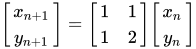
Since the eigenvalues are given by
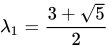
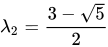
We know that the Lyapunov exponents are:
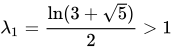
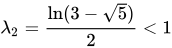
Therefore, it is a saddle point.
Flows
editLet be a C1 vector field with a critical point p, i.e., F(p) = 0, and let J denote the Jacobian matrix of F at p. If the matrix J has no eigenvalues with zero real parts then p is called hyperbolic. Hyperbolic fixed points may also be called hyperbolic critical points or elementary critical points.[3]

The Hartman–Grobman theorem states that the orbit structure of a dynamical system in a neighbourhood of a hyperbolic equilibrium point is topologically equivalent to the orbit structure of the linearized dynamical system.
Example
editConsider the nonlinear system
![{\displaystyle {\begin{aligned}{\frac {dx}{dt}}&=y,\\[5pt]{\frac {dy}{dt}}&=-x-x^{3}-\alpha y,~\alpha \neq 0\end{aligned}}}](https://wikimedia.org/api/rest_v1/media/math/render/svg/8f94314d229d84506a4f5a68d51e672d2fa3334b "{\displaystyle {\begin{aligned}{\frac {dx}{dt}}&=y,\\[5pt]{\frac {dy}{dt}}&=-x-x^{3}-\alpha y,~\alpha \neq 0\end{aligned}}}")
(0, 0) is the only equilibrium point. The Jacobian matrix of the linearization at the equilibrium point is
![{\displaystyle J(0,0)=\left[{\begin{array}{rr}0&1\\-1&-\alpha \end{array}}\right].}](https://wikimedia.org/api/rest_v1/media/math/render/svg/a9a02f9987490279fb5050b999d067f361ce42b3 "{\displaystyle J(0,0)=\left[{\begin{array}{rr}0&1\\-1&-\alpha \end{array}}\right].}")
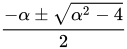
The eigenvalues of this matrix are . For all values of α ≠ 0, the eigenvalues have non-zero real part. Thus, this equilibrium point is a hyperbolic equilibrium point. The linearized system will behave similar to the non-linear system near (0, 0). When α = 0, the system has a nonhyperbolic equilibrium at (0, 0).
Comments
editIn the case of an infinite dimensional system—for example systems involving a time delay—the notion of the "hyperbolic part of the spectrum" refers to the above property.
See also
editNotes
edit- ^ Strogatz, Steven (2001). Nonlinear Dynamics and Chaos. Westview Press. ISBN 0-7382-0453-6.
- ^ Ott, Edward (1994). Chaos in Dynamical Systems. Cambridge University Press. ISBN 0-521-43799-7.
- ^ Abraham, Ralph; Marsden, Jerrold E. (1978). Foundations of Mechanics. Reading Mass.: Benjamin/Cummings. ISBN 0-8053-0102-X.
References
edit- Eugene M. Izhikevich (ed.). "Equilibrium". Scholarpedia.
