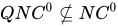
The hidden linear function problem, is a search problem that generalizes the Bernstein–Vazirani problem.[1] In the Bernstein–Vazirani problem, the hidden function is implicitly specified in an oracle; while in the 2D hidden linear function problem (2D HLF), the hidden function is explicitly specified by a matrix and a binary vector. 2D HLF can be solved exactly by a constant-depth quantum circuit restricted to a 2-dimensional grid of qubits using bounded fan-in gates but can't be solved by any sub-exponential size, constant-depth classical circuit using unbounded fan-in biased threshold gates.[2][3] While Bernstein–Vazirani's problem was designed to prove an oracle separation between complexity classes BQP and BPP, 2D HLF was designed to prove an explicit separation between the circuit classes and ().[1]


2D HLF problem statement
editGiven (an upper- triangular binary matrix of size ) and (a binary vector of length ),


define a function :


and

There exists a such that


Find .[1]

2D HLF algorithm
editWith 3 registers; the first holding , the second containing and the third carrying an -qubit state, the circuit has controlled gates which implement from the first two registers to the third.


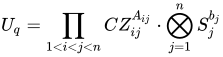
This problem can be solved by a quantum circuit, , where H is the Hadamard gate, S is the S gate and CZ is CZ gate. It is solved by this circuit because with , iff is a solution.[1]



References
edit- ^ a b c d Bravyi, Sergey; Gosset, David; Robert, König (2018-10-19). "Quantum advantage with shallow circuits". Science. 362 (6412): 308–311. arXiv:1704.00690. Bibcode:2018Sci...362..308B. doi:10.1126/science.aar3106. PMID 30337404. S2CID 16308940.
- ^ Watts, Adam Bene; Kothari, Robin; Schaeffer, Luke; Tal, Avishay (2019-06-23). "Exponential separation between shallow quantum circuits and unbounded fan-in shallow classical circuits". ACM: 515–526. arXiv:1906.08890. doi:10.1145/3313276.3316404. ISBN 978-1-4503-6705-9.
{{cite journal}}: Cite journal requires|journal=(help) - ^ de Oliveira, Michael; Subramanian, Sathyawageeswar; Mendes, Leandro; Hsieh, Min-Hsiu (2025-04-15). "Unconditional advantage of noisy qudit quantum circuits over biased threshold circuits in constant depth". Nature Communications. 16 (1): 3559. doi:10.1038/s41467-025-58545-4. ISSN 2041-1723. PMC 12000609. PMID 40234377.
