


In mathematics, an eigenform (meaning simultaneous Hecke eigenform with modular group SL(2,Z)) is a modular form that is an eigenvector for all Hecke operators Tm, m = 1, 2, 3, ....
Eigenforms fall into the realm of number theory, but can be found in other areas of math and science such as analysis, combinatorics, and physics. Common examples of eigenforms, and the only non-cuspidal eigenforms, are those of the Eisenstein series. Another example is the Δ function.
Normalization
editThere are two different normalizations for an eigenform (or for a modular form in general).
Algebraic normalization
editAn eigenform is said to be normalized when scaled so that the q-coefficient in its Fourier series is one:
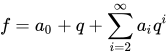
where q = e2πiz. As the function f is also an eigenvector under each Hecke operator Ti, it has a corresponding eigenvalue. More specifically ai, i ≥ 1 turns out to be the eigenvalue of f corresponding to the Hecke operator Ti. In the case when f is not a cusp form, the eigenvalues can be given explicitly.[1]
Analytic normalization
editAn eigenform which is cuspidal can be normalized with respect to its inner product:

Existence
editThe existence of eigenforms is a nontrivial result, but does come directly from the fact that the Hecke algebra is commutative.
Higher levels
editIn the case that the modular group is not the full SL(2,Z), there is not a Hecke operator for each n ∈ Z, and as such the definition of an eigenform is changed accordingly: an eigenform is a modular form which is a simultaneous eigenvector for all Hecke operators that act on the space.
References
edit- ^ Neal Koblitz (1984). "III.5". Introduction to Elliptic Curves and Modular Forms. ISBN 9780387960296.
