
In biochemistry, a Hanes–Woolf plot, Hanes plot, or plot of against is a graphical representation of enzyme kinetics in which the ratio of the initial substrate concentration to the reaction velocity is plotted against . It is based on the rearrangement of the Michaelis–Menten equation shown below:


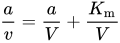
where is the Michaelis constant and is the limiting rate.[1]


J. B. S. Haldane stated, reiterating what he and K. G. Stern had written in their book,[2] that this rearrangement was due to Barnet Woolf.[3] It was one of three transformations introduced by Woolf. It was first published by C. S. Hanes, who did himself not use it as a plot.[4] Hanes said that the use of linear regression to determine kinetic parameters from this type of linear transformation generates the best fit between observed and calculated values of , rather than .[4]: 1415

Starting from the Michaelis–Menten equation:

we can take reciprocals of both sides of the equation to obtain the equation underlying the Lineweaver–Burk plot:

which can be multiplied on both sides by to give


Thus in the absence of experimental error data a plot of against yields a straight line of slope , an intercept on the ordinate of and an intercept on the abscissa of .


Like other techniques that linearize the Michaelis–Menten equation, the Hanes–Woolf plot was used historically for rapid determination of the kinetic parameters , and , but it has been largely superseded by nonlinear regression methods that are significantly more accurate and no longer computationally inaccessible. It remains useful, as a means to present data graphically.

See also
editReferences
edit- ^ The term maximum rate is often used, but not recommended by the IUBMB; see Cornish-Bowden, A (2014). "Current IUBMB recommendations on enzyme nomenclature and kinetics". Persp. Sci. 1 (1–6): 74–87. Bibcode:2014PerSc...1...74C. doi:10.1016/j.pisc.2014.02.006.
- ^ Haldane, John Burdon Sanderson; Stern, Kurt Günter (1932). Allgemeine Chemie der Enzyme. Wissenschaftliche Forschungsberichte, Naturwissenschaftliche Reihe, herausgegeben von Dr. Raphael Eduard Liesegang. Vol. 28. Dresden and Leipzig: Theodor Steinkopff. pp. 119–120. OCLC 964209806.
- ^ Haldane, John Burdon Sanderson (1957). "Graphical methods in enzyme chemistry". Nature. 179 (4564): 832. Bibcode:1957Natur.179R.832H. doi:10.1038/179832b0. S2CID 4162570.
- ^ a b Hanes, Charles Samuel (1932). "Studies on plant amylases: The effect of starch concentration upon the velocity of hydrolysis by the amylase of germinated barley". Biochemical Journal. 26 (5): 1406–1421. doi:10.1042/bj0261406. PMC 1261052. PMID 16744959.
