A Neumann series is a mathematical series that sums k-times repeated applications of an operator . This has the generator form


where is the k-times repeated application of ; is the identity operator and for . This is a special case of the generalization of a geometric series of real or complex numbers to a geometric series of operators. The generalized initial term of the series is the identity operator and the generalized common ratio of the series is the operator





The series is named after the mathematician Carl Neumann, who used it in 1877 in the context of potential theory. The Neumann series is used in functional analysis. It is closely connected to the resolvent formalism for studying the spectrum of bounded operators and, applied from the left to a function, it forms the Liouville-Neumann series that formally solves Fredholm integral equations.
Properties
editSuppose that is a bounded linear operator on the normed vector space . If the Neumann series converges in the operator norm, then is invertible and its inverse is the series:


- ,

where is the identity operator in . To see why, consider the partial sums
- .

Then we have

This result on operators is analogous to geometric series in .

One case in which convergence is guaranteed is when is a Banach space and in the operator norm; another compatible case is that converges. However, there are also results which give weaker conditions under which the series converges.


Example
editLet be given by:

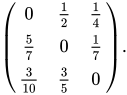
For the Neumann series to converge to as goes to infinity, the spectral norm of must be smaller than unity. This norm is about as can be checked numerically (e.g., by computing the singular values), confirming that the Neumann series converges.


Approximate matrix inversion
editA truncated Neumann series can be used for approximate matrix inversion. To approximate the inverse of an invertible matrix , consider that


for Then, using the Neumann series identity that if the appropriate norm condition on is satisfied, Since these terms shrink with increasing given the conditions on the norm, then truncating the series at some finite may give a practical approximation to the inverse matrix:


The set of invertible operators is open
editA corollary is that the set of invertible operators between two Banach spaces and is open in the topology induced by the operator norm. Indeed, let be an invertible operator and let be another operator. If , then is also invertible. Since , the Neumann series is convergent. Therefore, we have





Taking the norms, we get

The norm of can be bounded by


Applications
editThe Neumann series has been used for linear data detection in massive multiuser multiple-input multiple-output (MIMO) wireless systems. Using a truncated Neumann series avoids computation of an explicit matrix inverse, which reduces the complexity of linear data detection from cubic to square.[1]
Another application is the theory of propagation graphs which takes advantage of Neumann series to derive closed form expressions for transfer functions.
References
edit- ^ Wu, M.; Yin, B.; Vosoughi, A.; Studer, C.; Cavallaro, J. R.; Dick, C. (May 2013). "Approximate matrix inversion for high-throughput data detection in the large-scale MIMO uplink". 2013 IEEE International Symposium on Circuits and Systems (ISCAS2013). pp. 2155–2158. doi:10.1109/ISCAS.2013.6572301. hdl:1911/75011. ISBN 978-1-4673-5762-3. S2CID 389966.
- Werner, Dirk (2005). Funktionalanalysis (in German). Springer Verlag. ISBN 3-540-43586-7.
