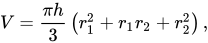
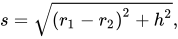
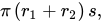
In geometry, a frustum (pl.frusta or frustums), is the portion of a solid (normally a pyramid or a cone) that lies between two parallel planes cutting the solid. In the case of a pyramid, the base faces are polygonal and the side faces are trapezoidal. A right frustum is a right pyramid or a right cone truncated perpendicularly to its axis;[1] otherwise, it is an oblique frustum.
In a truncated cone or truncated pyramid, the truncation plane is not necessarily parallel to the cone's base, as in a frustum.
If all its edges are the same length, then a frustum becomes a prism (possibly oblique or/and with irregular bases).
A frustum's axis is that of the original cone or pyramid. A frustum is circular if it has circular bases; it is right if the axis is perpendicular to both bases, and oblique otherwise.
The height of a frustum is the perpendicular distance between the planes of the two bases.
Cones and pyramids can be viewed as degenerate cases of frusta, where one of the cutting planes passes through the apex (so that the corresponding base reduces to a point). The pyramidal frusta are a subclass of prismatoids.
Two frusta with two congruent bases joined at these congruent bases make a bifrustum. and also the dual is cone,pyramid,and bifrustum
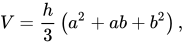
where a and b are the base and top side lengths, and h is the height.
The Egyptians knew the correct formula for the volume of such a truncated square pyramid, but no proof of this equation is given in the Moscow papyrus.
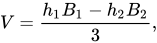
The volume of a conical or pyramidal frustum is the volume of the solid before slicing its "apex" off, minus the volume of this "apex":
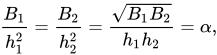
where B1 and B2 are the base and top areas, and h1 and h2 are the perpendicular heights from the apex to the base and top planes.
Considering that
the formula for the volume can be expressed as the third of the product of this proportionality, , and of the difference of the cubes of the heights h1 and h2 only:
By using the identity a3 − b3 = (a − b)(a2 + ab + b2), one gets:
where h1 − h2 = h is the height of the frustum.
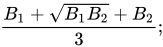
Distributing and substituting from its definition, the Heronian mean of areas B1 and B2 is obtained:
Ziggurats, step pyramids, and certain ancient Native American mounds also form the frustum of one or more pyramids, with additional features such as stairs added.
the other and is joined to it by alternating triangles and rectangles; Frusta obtained by truncation of a pyramid or a cone; Quadrilateral-faced hexahedral
The Whip and the Body (Italian: La frusta e il corpo) is a 1963 gothic horror film directed by Mario Bava under the alias "John M. Old". The film is about
Federico Fellini's classic 1960 film La Dolce Vita. Breakfast is served at La Frusta, which was once a main restaurant. It is on the first floor with a look
the customs, manners, drama, &c. of Italy, as they are described in the Frusta letteraria; and in the Account of Italy in English, written by Mr. Baretti;
usually the top and bottom congruent. It can be constructed as two congruent frusta combined across a plane of symmetry, and also as a bipyramid with the two
certain polyhedra with discrete rotational symmetry by composing right frusta has been implemented via a CAD program. The program allows users to specify