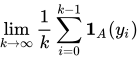
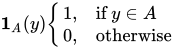
Let be an n-vertex expander graph with positively weighted edges, and let . Let denote the stochastic matrix of the graph, and let be the second largest eigenvalue of . Let denote the vertices encountered in a -step random walk on starting at vertex , and let . Where
(It is well known[1] that almost all trajectories converges to some limiting point, , as .)
The theorem states that for a weighted graph and a random walk where is chosen by an initial distribution , for all , we have the following bound:
Where is dependent on and .
The theorem gives a bound for the rate of convergence to with respect to the length of the random walk, hence giving a more efficient method to estimate compared to independent sampling the vertices of .
Proof
edit
In order to prove the theorem, we provide a few definitions followed by three lemmas.
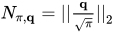
Let be the weight of the edge and let Denote by . Let be the matrix with entries , and let .
Let and . Let where is the stochastic matrix, and . Then:
Where . As and are symmetric, they have real eigenvalues. Therefore, as the eigenvalues of and are equal, the eigenvalues of are real. Let and be the first and second largest eigenvalue of respectively.
For convenience of notation, let , , , and let be the all-1 vector.
Where is the expectation of chosen according to the probability distribution . As this can be interpreted by summing over all possible trajectories , hence:
Combining the two results proves the lemma.
Lemma 2
For ,
Proof:
As eigenvalues of and are equal,
Lemma 3
If is a real number such that ,
Proof summary:
We Taylor expand about point to get:
Where are first and second derivatives of at . We show that We then prove that (i) by matrix manipulation, and then prove (ii) using (i) and Cauchy's estimate from complex analysis.
The results combine to show that
A line to line proof can be found in Gilman (1998)[1]
Proof of theorem
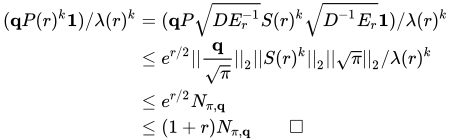
Combining lemma 2 and lemma 3, we get that
Interpreting the exponent on the right hand side of the inequality as a quadratic in and minimising the expression, we see that
A similar bound
holds, hence setting gives the desired result.
Uses
edit
This theorem is useful in randomness reductions in the study of derandomization,[2] showing that expander random walks are good pseudorandom generators against various classes of test functions. Sampling from an expander walk is an example of a randomness-efficient sampler. Note that the number of bits used in sampling independent samples from is , whereas if we sample from an infinite family of constant-degree expanders this costs only . Such families exist and are efficiently constructible, e.g. the Ramanujan graphs of Lubotzky-Phillips-Sarnak.
^Anand, Emile (2025). "Towards the Pseudorandomness of Expander Random Walks for Read-Once ACC0 circuits". arXiv:2501.07752 [cs.CC].
Ajtai, M.; Komlós, J.; Szemerédi, E. (1987). "Deterministic simulation in LOGSPACE". Proceedings of the nineteenth annual ACM symposium on Theory of computing. STOC '87. ACM. pp. 132–140. doi:10.1145/28395.28410. ISBN0897912217.
Gillman, D. (1998). "A Chernoff Bound for Random Walks on Expander Graphs". SIAM Journal on Computing. 27 (4). Society for Industrial and Applied Mathematics: 1203–1220. doi:10.1137/S0097539794268765. S2CID26319459.
theory, an expander graph is a sparse graph that has strong connectivity properties, quantified using vertex, edge or spectral expansion. Expander constructions
strategy. Walk Forward Analysis was presented by Robert E. Pardo in his book "Design, Testing and Optimization of Trading Systems" in 1992 and expanded in the
Slice sampling is a type of Markov chain Monte Carlo algorithm for pseudo-random number sampling, i.e. for drawing random samples from a statistical distribution
of Reed–Solomon codes with the Wozencraft ensemble) as well as expander walk sampling. Alon et al. (1992) achieve s = O ( n ϵ log ( n / ϵ ) ) 2 {\displaystyle
component-wise updating idea, later known as Gibbs sampling. Simultaneously, the theoretical foundations for Gibbs sampling were being developed, such as the Hammersley–Clifford
vary by state, and, within a state, may vary by county or municipality. A sampling of US cities found fines ranging from $1 to $1,000. Enforcement of jaywalking
Fashion Week is also of global importance. In a typical fashion show, models walk the catwalk dressed in the clothing created by the designer. Clothing is







![{\displaystyle \Pr \left[{\bigg |}{\frac {1}{k}}\sum _{i=0}^{k-1}\mathbf {1} _{A}(y_{i})-\pi (A){\bigg |}\geq \gamma \right]\leq Ce^{-{\frac {1}{20}}(\gamma ^{2}(1-\lambda _{2})k)}.}](https://wikimedia.org/api/rest_v1/media/math/render/svg/38bed3949aff40e40f155072aa5532cd9ed4f4ff)



















![{\displaystyle \Pr \left[t_{k}-\pi (A)\geq \gamma \right]\leq e^{-rk(\pi (A)+\gamma )+k\log \lambda (r)}(\mathbf {q} P(r)^{k}\mathbf {1} )/\lambda (r)^{k}}](https://wikimedia.org/api/rest_v1/media/math/render/svg/8f8d3df0c1f6f2b9fae0a3eb946489271df70846)
![{\displaystyle {\begin{alignedat}{2}\Pr \left[t_{k}\geq \pi (A)+\gamma \right]=\Pr[e^{rt_{k}}\geq e^{rk(\pi (A)+\gamma )}]\leq e^{-rk(\pi (A)+\gamma )}E_{\mathbf {q} }e^{rt_{k}}\end{alignedat}}}](https://wikimedia.org/api/rest_v1/media/math/render/svg/5b3d375fcf90c73feba4e6a26bae88003d51d5d5)


















![{\displaystyle \Pr[t_{k}-\pi (A)\geq \gamma ]\leq (1+r)N_{\pi ,\mathbf {q} }e^{-k(r\gamma -5r^{2}/\epsilon )}}](https://wikimedia.org/api/rest_v1/media/math/render/svg/b532c43c54c038ea3611a22a4960a3530f15e35a)
![{\displaystyle \Pr[t_{k}-\pi (A)\geq \gamma ]\leq (1+\gamma \epsilon /10)N_{\pi ,\mathbf {q} }e^{-k\gamma ^{2}\epsilon /20}}](https://wikimedia.org/api/rest_v1/media/math/render/svg/0bd1ff816d44ebe381f6c6632735cda6d8cd83bf)
![{\displaystyle \Pr[t_{k}-\pi (A)\leq -\gamma ]\leq (1+\gamma \epsilon /10)N_{\pi ,\mathbf {q} }e^{-k\gamma ^{2}\epsilon /20}}](https://wikimedia.org/api/rest_v1/media/math/render/svg/ec45eb89d6e8c1c0bca939ceab3e0652b231aa0a)



