


In category theory, the notion of a projective object generalizes the notion of a projective module. Projective objects in abelian categories are used in homological algebra. The dual notion of a projective object is that of an injective object.
Definition
editAn object in a category is projective if for any epimorphism and morphism , there is a morphism such that , i.e. the following diagram commutes:


That is, every morphism factors through every epimorphism .[1]


If C is locally small, i.e., in particular is a set for any object X in C, this definition is equivalent to the condition that the hom functor (also known as corepresentable functor)
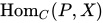

preserves epimorphisms.[2]
Projective objects in abelian categories
editIf the category C is an abelian category such as, for example, the category of abelian groups, then P is projective if and only if

is an exact functor, where Ab is the category of abelian groups.
An abelian category is said to have enough projectives if, for every object of , there is a projective object of and an epimorphism from P to A or, equivalently, a short exact sequence


The purpose of this definition is to ensure that any object A admits a projective resolution, i.e., a (long) exact sequence

where the objects are projective.

Projectivity with respect to restricted classes
editSemadeni (1963) discusses the notion of projective (and dually injective) objects relative to a so-called bicategory, which consists of a pair of subcategories of "injections" and "surjections" in the given category C. These subcategories are subject to certain formal properties including the requirement that any surjection is an epimorphism. A projective object (relative to the fixed class of surjections) is then an object P so that Hom(P, −) turns the fixed class of surjections (as opposed to all epimorphisms) into surjections of sets (in the usual sense).
Properties
edit- The coproduct of two projective objects is projective.[3]
- A retract of a projective object is projective.[4]
Examples
editThe statement that all sets are projective is equivalent to the axiom of choice.
The projective objects in the category of abelian groups are the free abelian groups.
Let be a ring with identity. Consider the (abelian) category -Mod of left -modules. The projective objects in -Mod are precisely the projective left R-modules. Consequently, is itself a projective object in -Mod. Dually, the injective objects in -Mod are exactly the injective left R-modules.

The category of left (right) -modules also has enough projectives. This is true since, for every left (right) -module , we can take to be the free (and hence projective) -module generated by a generating set for (for example we can take to be ). Then the canonical projection is the required surjection.


The projective objects in the category of compact Hausdorff spaces are precisely the extremally disconnected spaces. This result is due to Gleason (1958), with a simplified proof given by Rainwater (1959).
In the category of Banach spaces and contractions (i.e., functionals whose norm is at most 1), the epimorphisms are precisely the maps with dense image. Wiweger (1969) shows that the zero space is the only projective object in this category. There are non-trivial spaces, though, which are projective with respect to the class of surjective contractions. In the category of normed vector spaces with contractions (and surjective maps as "surjections"), the projective objects are precisely the -spaces.[5]


References
edit- ^ Awodey (2010, §2.1)
- ^ Mac Lane (1978, p. 118)
- ^ Awodey (2010, p. 72)
- ^ Awodey (2010, p. 33)
- ^ Semadeni (1963)
- Awodey, Steve (2010), Category theory (2nd ed.), Oxford: Oxford University Press, ISBN 9780199237180, OCLC 740446073
- Gleason, Andrew M. (1958), "Projective topological spaces", Illinois Journal of Mathematics, 2 (4A): 482–489, doi:10.1215/ijm/1255454110, MR 0121775
- Mac Lane, Saunders (1978), Categories for the Working Mathematician (Second ed.), New York, NY: Springer New York, p. 114, ISBN 1441931236, OCLC 851741862
- Mitchell, Barry (1965). Theory of categories. Pure and applied mathematics. Vol. 17. Academic Press. ISBN 978-0-124-99250-4. MR 0202787.
- Pothoven, Kenneth (1969), "Projective and Injective Objects in the Category of Banach Spaces", Proceedings of the American Mathematical Society, 22 (2): 437–438, doi:10.2307/2037073, JSTOR 2037073
- Rainwater, John (1959), "A Note on Projective Resolutions", Proceedings of the American Mathematical Society, 10 (5): 734–735, doi:10.2307/2033466, JSTOR 2033466
- Semadeni, Z. (1963), "Projectivity, injectivity and duality", Rozprawy Mat., 35, MR 0154832
External links
editprojective object at the nLab
