Discrepancy of hypergraphs is an area of discrepancy theory that studies the discrepancy of general set systems.
Definitions
editIn the classical setting, we aim at partitioning the vertices of a hypergraph into two classes in such a way that ideally each hyperedge contains the same number of vertices in both classes. A partition into two classes can be represented by a coloring . We call −1 and +1 colors. The color-classes and form the corresponding partition. For a hyperedge , set




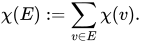
The discrepancy of with respect to and the discrepancy of are defined by




These notions as well as the term 'discrepancy' seem to have appeared for the first time in a paper of Beck.[1] Earlier results on this problem include the famous lower bound on the discrepancy of arithmetic progressions by Roth[2] and upper bounds for this problem and other results by Erdős and Spencer[3][4] and Sárközi.[5]: 39 At that time, discrepancy problems were called quasi-Ramsey problems.
Examples
editTo get some intuition for this concept, let's have a look at a few examples.
- If all edges of intersect trivially, i.e. for any two distinct edges , then the discrepancy is zero, if all edges have even cardinality, and one, if there is an odd cardinality edge.
- The other extreme is marked by the complete hypergraph . In this case the discrepancy is . Any 2-coloring will have a color class of at least this size, and this set is also an edge. On the other hand, any coloring with color classes of size and proves that the discrepancy is not larger than . It seems that the discrepancy reflects how chaotic the hyperedges of intersect. Things are not that easy, however, as the following example shows.
- Set , and . In words, is the hypergraph on 4k vertices {1,...,4k}, whose edges are all subsets that have the same number of elements in {1,...,2k} as in {2k+1,...,4k}. Now has many (more than ) complicatedly intersecting edges. However, its discrepancy is zero, since we can color {1,...,2k} in one color and {2k+1,...,4k} in another color.



![{\displaystyle {\mathcal {H}}_{n}=([n],\{E\subseteq [n]\mid |E\cap [2k]|=|E\setminus [2k]|\})}](https://wikimedia.org/api/rest_v1/media/math/render/svg/0056f629c5ddbee1bf6acf5d10afdb061bbf810d "{\displaystyle {\mathcal {H}}_{n}=([n],\{E\subseteq [n]\mid |E\cap [2k]|=|E\setminus [2k]|\})}")

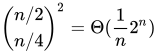
The last example shows that we cannot expect to determine the discrepancy by looking at a single parameter like the number of hyperedges. Still, the size of the hypergraph yields first upper bounds.
General hypergraphs
edit1. For any hypergraph with n vertices and m edges:
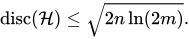
The proof is a simple application of the probabilistic method. Let be a random coloring, i.e. we have


independently for all . Since is a sum of independent −1, 1 random variables. So we have for all and . Taking gives

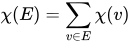



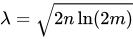

Since a random coloring with positive probability has discrepancy at most , in particular, there are colorings that have discrepancy at most . Hence


2. For any hypergraph with n vertices and m edges such that :


To prove this, a much more sophisticated approach using the entropy function was necessary. Of course this is particularly interesting for . In the case , can be shown for n large enough. Therefore, this result is usually known to as 'Six Standard Deviations Suffice'. It is considered to be one of the milestones of discrepancy theory. The entropy method has seen numerous other applications, e.g. in the proof of the tight upper bound for the arithmetic progressions of Matoušek and Spencer[6] or the upper bound in terms of the primal shatter function due to Matoušek.[7]



Hypergraphs of bounded degree
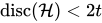
editBetter discrepancy bounds can be attained when the hypergraph has a bounded degree, that is, each vertex of is contained in at most t edges, for some small t. In particular:
- Beck and Fiala[8] proved that ; this is known as the Beck–Fiala theorem. They conjectured that .
- Bednarchak and Helm[9] and Helm[10] improved the Beck-Fiala bound in tiny steps to (for a slightly restricted situation, i.e. ).
- Bukh[11] improved this in 2016 to , where denotes the iterated logarithm.
- A corollary of Beck's paper[1] – the first time the notion of discrepancy explicitly appeared – shows for some constant C.
- The latest improvement in this direction is due to Banaszczyk:[12] .






Special hypergraphs
editBetter bounds on the discrepancy are possible for hypergraphs with a special structure, such as:
- Discrepancy of permutations - when the vertices are the integers 1,...,n, and the hyperedges are all the intervals of some m given permutations on the integers.
- Geometric discrepancy - when the vertices are points in a Euclidean space, and the hyperedges are geometric objects, such as rectangles or half-spaces.
- Arithmetic progressions (Roth, Sárközy, Beck, Matoušek & Spencer)
- Six Standard Deviations Suffice (Spencer)
Major open problems
editApplications
edit- Numerical Integration: Monte Carlo methods in high dimensions.
- Computational Geometry: Divide and conquer algorithms.
- Image Processing: Halftoning
Notes
edit- ^ a b J. Beck: "Roth's estimate of the discrepancy of integer sequences is nearly sharp", page 319-325. Combinatorica, 1, 1981
- ^ K. F. Roth: "Remark concerning integer sequences", pages 257–260. Acta Arithmetica 9, 1964
- ^ J. Spencer: "A remark on coloring integers", pages 43–44. Canadian Mathematical Bulletin 15, 1972.
- ^ P. Erdős and J. Spencer: "Imbalances in k-colorations", pages 379–385. Networks 1, 1972.
- ^ P. Erdős and J. Spencer: "Probabilistic Methods in Combinatorics." Budapest: Akadémiai Kiadó, 1974.
- ^ J. Matoušek and J. Spencer: "Discrepancy in arithmetic progressions", pages 195–204. Journal of the American Mathematical Society 9, 1996.
- ^ J. Matoušek: "Tight upper bound for the discrepancy of half-spaces", pages 593–601. Discrepancy and Computational Geometry 13, 1995.
- ^ J. Beck and T. Fiala: "Integer making theorems", pages 1–8. Discrete Applied Mathematics 3, 1981.
- ^ D. Bednarchak and M. Helm: "A note on the Beck-Fiala theorem", pages 147–149. Combinatorica 17, 1997.
- ^ M. Helm: "On the Beck-Fiala theorem", page 207. Discrete Mathematics 207, 1999.
- ^ B. Bukh: "An Improvement of the Beck–Fiala Theorem", pp. 380-398. Combinatorics, Probability and Computing 25, 2016.
- ^ Banaszczyk, W. (1998), "Balancing vectors and Gaussian measure of n-dimensional convex bodies", Random Structures & Algorithms, 12: 351–360, doi:10.1002/(SICI)1098-2418(199807)12:4<351::AID-RSA3>3.0.CO;2-S.
- ^ Bansal, Nikhil; Dadush, Daniel; Garg, Shashwat (January 2019). "An Algorithm for Komlós Conjecture Matching Banaszczyk's Bound". SIAM Journal on Computing. 48 (2): 534–553. doi:10.1137/17M1126795. ISSN 0097-5397.
References
edit- Beck, József; Chen, William W. L. (2009). Irregularities of Distribution. Cambridge University Press. ISBN 978-0-521-09300-2.
- Chazelle, Bernard (2000). The Discrepancy Method: Randomness and Complexity. Cambridge University Press. ISBN 0-521-77093-9.
- Doerr, Benjamin (2005). Integral Approximation (PDF) (Habilitation thesis). University of Kiel. OCLC 255383176. Retrieved 20 October 2019.
- Matoušek, Jiří (1999). Geometric Discrepancy: An Illustrated Guide. Springer. ISBN 3-540-65528-X.
