


This article includes a list of references, related reading, or external links, but its sources remain unclear because it lacks inline citations. (July 2017) |
In differential geometry, the Cotton tensor on a pseudo-Riemannian manifold of dimension n is a third-order tensor concomitant of the metric tensor. The vanishing of the Cotton tensor for n = 3 is necessary and sufficient condition for the manifold to be locally conformally flat. By contrast, in dimensions n ≥ 4, the vanishing of the Cotton tensor is necessary but not sufficient for the metric to be conformally flat; instead, the corresponding necessary and sufficient condition in these higher dimensions is the vanishing of the Weyl tensor, while the Cotton tensor just becomes a constant times the divergence of the Weyl tensor. For n < 3 the Cotton tensor is identically zero. The concept is named after Émile Cotton.
The proof of the classical result that for n = 3 the vanishing of the Cotton tensor is equivalent to the metric being conformally flat is given by Eisenhart using a standard integrability argument. This tensor density is uniquely characterized by its conformal properties coupled with the demand that it be differentiable for arbitrary metric tensors, as shown by Aldersley (1979). The Cotton tensor is a component of the full Cartan conformal curvature in all dimensions , the other component being the Weyl curvature.

Recently, the study of three-dimensional spaces is becoming of great interest, because the Cotton tensor restricts the relation between the Ricci tensor and the energy–momentum tensor in the Einstein equations and plays an important role in the Hamiltonian formalism of general relativity.
Definition
editIn coordinates, and denoting the Ricci tensor by Rij and the scalar curvature by R, the components of the Cotton tensor are

The Cotton tensor can be regarded as a vector valued 2-form, and for n = 3 the Hodge star operator converts this into a second-order trace-free tensor density:
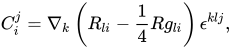
sometimes called the Cotton–York tensor.
Properties
editConformal rescaling
editUnder conformal rescaling of the metric for some scalar function , we see that the Christoffel symbols transform as


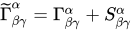
where is the tensor


The Riemann curvature tensor transforms as

In -dimensional manifolds, we obtain the Ricci tensor by contracting the transformed Riemann tensor to see it transform as


Similarly the Ricci scalar transforms as

Combining all these facts together permits us to conclude the Cotton–York tensor transforms as

or using coordinate independent language as

where the gradient is contracted with the Weyl tensor W.
Symmetries
editThe Cotton tensor has the following symmetries:

and therefore[clarification needed]
![{\displaystyle C_{[ijk]}=0.}](https://wikimedia.org/api/rest_v1/media/math/render/svg/6c3c881f84b5665847548ee7afa14362118299c1 "{\displaystyle C_{[ijk]}=0.}")
In addition the Bianchi formula for the Weyl tensor can be rewritten as

where is the positive divergence in the first component of W.

References
edit- Aldersley, S. J. (1979). "Comments on certain divergence-free tensor densities in a 3-space". Journal of Mathematical Physics. 20 (9): 1905–1907. Bibcode:1979JMP....20.1905A. doi:10.1063/1.524289.
- Choquet-Bruhat, Yvonne (2009). General Relativity and the Einstein Equations. Oxford, England: Oxford University Press. ISBN 978-0-19-923072-3.
- Cotton, É. (1899). "Sur les variétés à trois dimensions". Annales de la Faculté des Sciences de Toulouse. II. 1 (4): 385–438. Archived from the original on 2007-10-10.
- Eisenhart, Luther P. (1977) [1925]. Riemannian Geometry. Princeton, NJ: Princeton University Press. ISBN 0-691-08026-7.
- Garcia, A.; Hehl, F.W.; Heinicke, C.; Macias, A. (2004). "The Cotton tensor in Riemannian spacetimes". Classical and Quantum Gravity. 21 (4): 1099–1118. arXiv:gr-qc/0309008. Bibcode:2004CQGra..21.1099G. doi:10.1088/0264-9381/21/4/024.

