Venn diagram of information theoretic measures for three variables , , and , represented by the lower left, lower right, and upper circles, respectively. The conditional mutual informations , and are represented by the yellow, cyan, and magenta regions, respectively.
For random variables , , and with support sets, and , we define the conditional mutual information as
.
This may be written in terms of the expectation operator: .
Thus is the expected (with respect to ) Kullback–Leibler divergence from the conditional joint distribution to the product of the conditional marginals and . Compare with the definition of mutual information.
In terms of PMFs for discrete distributions
edit
For discrete random variables , , and with support sets, and , the conditional mutual information is as follows
where the marginal, joint, and/or conditional probability mass functions are denoted by with the appropriate subscript. This can be simplified as
.
In terms of PDFs for continuous distributions
edit
For (absolutely) continuous random variables , , and with support sets, and , the conditional mutual information is as follows
where the marginal, joint, and/or conditional probability density functions are denoted by with the appropriate subscript. This can be simplified as
.
Some identities
edit
Alternatively, we may write in terms of joint and conditional entropies as[3]
This can be rewritten to show its relationship to mutual information
usually rearranged as the chain rule for mutual information
Or as an expected value of simpler Kullback–Leibler divergences:
,
.
More general definition
edit
A more general definition of conditional mutual information, applicable to random variables with continuous or other arbitrary distributions, will depend on the concept of regular conditional probability.[4]
Let be a probability space, and let the random variables , , and each be defined as a Borel-measurable function from to some state space endowed with a topological structure.
Consider the Borel measure (on the σ-algebra generated by the open sets) in the state space of each random variable defined by assigning each Borel set the -measure of its preimage in . This is called the pushforward measure The support of a random variable is defined to be the topological support of this measure, i.e.
where the limit is taken over the open neighborhoods of , as they are allowed to become arbitrarily smaller with respect to set inclusion.
Finally we can define the conditional mutual information via Lebesgue integration:
where the integrand is the logarithm of a Radon–Nikodym derivative involving some of the conditional probability measures we have just defined.
Note on notation
edit
In an expression such as and need not necessarily be restricted to representing individual random variables, but could also represent the joint distribution of any collection of random variables defined on the same probability space. As is common in probability theory, we may use the comma to denote such a joint distribution, e.g. Hence the use of the semicolon (or occasionally a colon or even a wedge ) to separate the principal arguments of the mutual information symbol. (No such distinction is necessary in the symbol for joint entropy, since the joint entropy of any number of random variables is the same as the entropy of their joint distribution.)
Properties
edit
Nonnegativity
edit
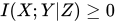
It is always true that
,
for discrete, jointly distributed random variables , and . This result has been used as a basic building block for proving other inequalities in information theory, in particular, those known as Shannon-type inequalities. Conditional mutual information is also non-negative for continuous random variables under certain regularity conditions.[5]
Interaction information
edit
Conditioning on a third random variable may either increase or decrease the mutual information: that is, the difference , called the interaction information, may be positive, negative, or zero. This is the case even when random variables are pairwise independent. Such is the case when: in which case , and are pairwise independent and in particular , but (Y here is the xor of X and Z so Z acts as the "secret key" for "plaintext" X and ciphertext "Y")
Chain rule for mutual information
edit
The chain rule (as derived above) provides two ways to decompose :
The data processing inequality is closely related to conditional mutual information and can be proven using the chain rule.
The conditional mutual information is used to inductively define the interaction information, a generalization of mutual information, as follows:
where
Because the conditional mutual information can be greater than or less than its unconditional counterpart, the interaction information can be positive, negative, or zero, which makes it hard to interpret.
^D. Leao, Jr. et al. Regular conditional probability, disintegration of probability and Radon spaces. Proyecciones. Vol. 23, No. 1, pp. 15–29, May 2004, Universidad Católica del Norte, Antofagasta, Chile PDF
In probability theory and information theory, the mutual information (MI) of two random variables is a measure of the mutual dependence between the two
In information theory, the conditional entropy quantifies the amount of information needed to describe the outcome of a random variable Y {\displaystyle
generalization of quantities of information to continuous distributions), and the conditional mutual information. Also, pragmatic information has been proposed as
interpretation in algebraic topology. The conditional mutual information can be used to inductively define the interaction information for any finite number of variables
entropy measures such as Rényi entropy. Transfer entropy is conditional mutual information, with the history of the influenced variable Y t − 1 : t − L
Redundancy (information theory). The characterization here imposes an additive property with respect to a partition of a set. Meanwhile, the conditional probability
Z {\displaystyle Z} are conditionally independent, given Y {\displaystyle Y} , which means the conditional mutual information, I ( X ; Z ∣ Y ) = 0 {\displaystyle



![{\displaystyle I(X;Y|Z)=\mathbb {E} _{Z}[D_{\mathrm {KL} }(P_{(X,Y)|Z}\|P_{X|Z}\otimes P_{Y|Z})]}](https://wikimedia.org/api/rest_v1/media/math/render/svg/56aec3a293135f20ff795c31055d1e5b10a15f67 "{\displaystyle I(X;Y|Z)=\mathbb {E} _{Z}[D_{\mathrm {KL} }(P_{(X,Y)|Z}\|P_{X|Z}\otimes P_{Y|Z})]}")












![{\displaystyle I(X;Y|Z)=D_{\mathrm {KL} }[p(X,Y,Z)\|p(X|Z)p(Y|Z)p(Z)].}](https://wikimedia.org/api/rest_v1/media/math/render/svg/52cae5fc4965592894b22f35839823c8fd89ea44 "{\displaystyle I(X;Y|Z)=D_{\mathrm {KL} }[p(X,Y,Z)\|p(X|Z)p(Y|Z)p(Z)].}")
![{\displaystyle I(X;Y|Z)=\sum _{z\in {\mathcal {Z}}}p(Z=z)D_{\mathrm {KL} }[p(X,Y|z)\|p(X|z)p(Y|z)]}](https://wikimedia.org/api/rest_v1/media/math/render/svg/b7b8329ea8d3f9c192e1ae67e23ef56afa43ce89 "{\displaystyle I(X;Y|Z)=\sum _{z\in {\mathcal {Z}}}p(Z=z)D_{\mathrm {KL} }[p(X,Y|z)\|p(X|z)p(Y|z)]}")
![{\displaystyle I(X;Y|Z)=\sum _{y\in {\mathcal {Y}}}p(Y=y)D_{\mathrm {KL} }[p(X,Z|y)\|p(X|Z)p(Z|y)]}](https://wikimedia.org/api/rest_v1/media/math/render/svg/b6eb9559b983260a6e05207f1eda1a0e2d23f083 "{\displaystyle I(X;Y|Z)=\sum _{y\in {\mathcal {Y}}}p(Y=y)D_{\mathrm {KL} }[p(X,Z|y)\|p(X|Z)p(Z|y)]}")




















![{\displaystyle I(X_{1};\,...\,;X_{n-1}|X_{n})=\mathbb {E} _{X_{n}}{\bigl [}I(X_{1};\,...\,;X_{n-1})|X_{n}{\bigr ]}.}](https://wikimedia.org/api/rest_v1/media/math/render/svg/734ca3932f87c50288ba45c34197a991d2cd1008 "{\displaystyle I(X_{1};\,...\,;X_{n-1}|X_{n})=\mathbb {E} _{X_{n}}{\bigl [}I(X_{1};\,...\,;X_{n-1})|X_{n}{\bigr ]}.}")

