In the mathematical theory of probability, a Borel right process, named after Émile Borel, is a particular kind of continuous-time random process.
Let  be a locally compact, separable, metric space.
We denote by
be a locally compact, separable, metric space.
We denote by  the Borel subsets of .
Let
the Borel subsets of .
Let  be the space of right continuous maps from
  to that have left limits in ,
and for each
to that have left limits in ,
and for each  , denote by
  the coordinate map at
  ; for
each
; for
each  ,
,  is the value of
  at .
We denote the universal completion of by
at .
We denote the universal completion of by  .
For each , let
.
For each , let
![{\displaystyle {\mathcal {F}}_{t}=\sigma \left\{X_{s}^{-1}(B):s\in [0,t],B\in {\mathcal {E}}\right\},}](https://wikimedia.org/api/rest_v1/media/math/render/svg/d71e1ce2ca2a456b13dd259d338eeadc41c30ab2 "{\displaystyle {\mathcal {F}}_{t}=\sigma \left\{X_{s}^{-1}(B):s\in [0,t],B\in {\mathcal {E}}\right\},}")
![{\displaystyle {\mathcal {F}}_{t}^{*}=\sigma \left\{X_{s}^{-1}(B):s\in [0,t],B\in {\mathcal {E}}^{*}\right\},}](https://wikimedia.org/api/rest_v1/media/math/render/svg/b6ad0db6b3f6501bed46d401cc7bd4ff7f5b9a5e "{\displaystyle {\mathcal {F}}_{t}^{*}=\sigma \left\{X_{s}^{-1}(B):s\in [0,t],B\in {\mathcal {E}}^{*}\right\},}")
and then, let


For each Borel measurable function  on , define, for each
  ,
,
![{\displaystyle U^{\alpha }f(x)=\mathbf {E} ^{x}\left[\int _{0}^{\infty }e^{-\alpha t}f(X_{t})\,dt\right].}](https://wikimedia.org/api/rest_v1/media/math/render/svg/bbcb6bcdfd5b5f17f331d6e0d2f04446c526720e "{\displaystyle U^{\alpha }f(x)=\mathbf {E} ^{x}\left[\int _{0}^{\infty }e^{-\alpha t}f(X_{t})\,dt\right].}")
Since ![{\displaystyle P_{t}f(x)=\mathbf {E} ^{x}\left[f(X_{t})\right]}](https://wikimedia.org/api/rest_v1/media/math/render/svg/b0eb90a16534fa2d55c166366db8e05da8fa67da "{\displaystyle P_{t}f(x)=\mathbf {E} ^{x}\left[f(X_{t})\right]}") and the mapping given by
and the mapping given by  is right continuous, we see that
for any uniformly continuous function , we have the mapping given by
is right continuous, we see that
for any uniformly continuous function , we have the mapping given by  is right continuous.
Therefore, together with the monotone class theorem, for any universally measurable function , the mapping given by  , is jointly measurable, that is,
  measurable, and subsequently, the mapping is also
  -measurable for all finite measures
  on
on  and
and  on .
Here,
is the completion of
with respect
to the product measure
on .
Here,
is the completion of
with respect
to the product measure  .
Thus, for any bounded universally measurable function on ,
the mapping is Lebesgue measurable, and hence,
for each
.
Thus, for any bounded universally measurable function on ,
the mapping is Lebesgue measurable, and hence,
for each  , one can define
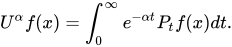
There is enough joint measurability to check that  is a Markov resolvent on
  ,
which uniquely associated with the Markovian semigroup
,
which uniquely associated with the Markovian semigroup  .
Consequently, one may apply Fubini's theorem to see that
.
Consequently, one may apply Fubini's theorem to see that
![{\displaystyle U^{\alpha }f(x)=\mathbf {E} ^{x}\left[\int _{0}^{\infty }e^{-\alpha t}f(X_{t})dt\right].}](https://wikimedia.org/api/rest_v1/media/math/render/svg/ab11a46f95ce2f2dd0a999488d848b26c8827892 "{\displaystyle U^{\alpha }f(x)=\mathbf {E} ^{x}\left[\int _{0}^{\infty }e^{-\alpha t}f(X_{t})dt\right].}")
The following are the defining properties of Borel right processes:[1]
- For each probability measure on
 , there exists a probability measure
  on
on  such that
 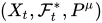 is a Markov process with initial measure and transition semigroup .
- Let be
 -excessive for the resolvent on . Then, for each probability measure on , a mapping given by
  is
is  almost surely right continuous on .
Notes
edit
References
edit
- Sharpe, Michael (1988), General Theory of Markov Processes, ISBN 0126390606
