This article provides insufficient context for those unfamiliar with the subject. (September 2018) |
In mathematics, the Bessel–Maitland function, or Wright generalized Bessel function, is a generalization of the Bessel function, introduced by Edward Maitland Wright (1934). It allows to model more complex phenomena by providing solutions to a broader class of fractional-order differential equations than possible with standard Bessel functions.
Etymology
editThe name "Bessel–Maitland function" contains a historical misnomer—"Maitland" appears in the function's name due to a confusion between Edward Maitland Wright's middle name and surname. While Wright is correctly recognized as the mathematician who generalized Johann Friedrich Bessel's original work, this nomenclature error has persisted in the mathematical literature.
Definition
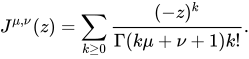
editThe function is given by
References
edit- Wright, E. M. (1934), "The asymptotic expansion of the generalized Bessel function.", Proceedings of the London Mathematical Society: 257–270, doi:10.1112/plms/s2-38.1.257, JFM 60.0306.02
 | This applied mathematics–related article is a stub. You can help Wikipedia by adding missing information. |
