


In statistics, Basu's theorem states that any boundedly complete and sufficient statistic is independent of any ancillary statistic. This is a 1955 result of Debabrata Basu.[1]
It is often used in statistics as a tool to prove independence of two statistics, by first demonstrating one is complete sufficient and the other is ancillary, then appealing to the theorem.[2] An example of this is to show that the sample mean and sample variance of a normal distribution are independent statistics, which is done in the Example section below. This property (independence of sample mean and sample variance) characterizes normal distributions.
Statement
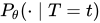
editLet be a family of distributions on a measurable space and a statistic maps from to some measurable space . If is a boundedly complete sufficient statistic for , and is ancillary to , then conditional on , is independent of . That is, .


Proof
editLet and be the marginal distributions of and respectively.


Denote by the preimage of a set under the map . For any measurable set we have



The distribution does not depend on because is ancillary. Likewise, does not depend on because is sufficient. Therefore
![{\displaystyle \int _{Y}{\big [}P(A^{-1}(B)\mid T=t)-P^{A}(B){\big ]}\ P_{\theta }^{T}(dt)=0.}](https://wikimedia.org/api/rest_v1/media/math/render/svg/b6cc0fe61d53347d8e1aee2544915a45ac9fd60d "{\displaystyle \int _{Y}{\big [}P(A^{-1}(B)\mid T=t)-P^{A}(B){\big ]}\ P_{\theta }^{T}(dt)=0.}")
Note the integrand (the function inside the integral) is a function of and not . Therefore, since is boundedly complete the function


is zero for almost all values of and thus

for almost all . Therefore, is independent of .
Example
editIndependence of sample mean and sample variance of a normal distribution
editLet X1, X2, ..., Xn be independent, identically distributed normal random variables with mean μ and variance σ2.
Then with respect to the parameter μ, one can show that

the sample mean, is a complete and sufficient statistic – it is all the information one can derive to estimate μ, and no more – and
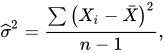
the sample variance, is an ancillary statistic – its distribution does not depend on μ.
Therefore, from Basu's theorem it follows that these statistics are independent conditional on , conditional on .


This independence result can also be proven by Cochran's theorem.
Further, this property (that the sample mean and sample variance of the normal distribution are independent) characterizes the normal distribution – no other distribution has this property.[3]
Notes
edit- ^ Basu (1955)
- ^ Ghosh, Malay; Mukhopadhyay, Nitis; Sen, Pranab Kumar (2011), Sequential Estimation, Wiley Series in Probability and Statistics, vol. 904, John Wiley & Sons, p. 80, ISBN 9781118165911,
The following theorem, due to Basu ... helps us in proving independence between certain types of statistics, without actually deriving the joint and marginal distributions of the statistics involved. This is a very powerful tool and it is often used ...
- ^ Geary, R.C. (1936). "The Distribution of "Student's" Ratio for Non-Normal Samples". Supplement to the Journal of the Royal Statistical Society. 3 (2): 178–184. doi:10.2307/2983669. JFM 63.1090.03. JSTOR 2983669.
This article includes a list of general references, but it lacks sufficient corresponding inline citations. (December 2009) |
References
edit- Basu, D. (1955). "On Statistics Independent of a Complete Sufficient Statistic". Sankhyā. 15 (4): 377–380. JSTOR 25048259. MR 0074745. Zbl 0068.13401.
- Mukhopadhyay, Nitis (2000). Probability and Statistical Inference. Statistics: A Series of Textbooks and Monographs. 162. Florida: CRC Press USA. ISBN 0-8247-0379-0.
- Boos, Dennis D.; Oliver, Jacqueline M. Hughes (Aug 1998). "Applications of Basu's Theorem". The American Statistician. 52 (3): 218–221. doi:10.2307/2685927. JSTOR 2685927. MR 1650407.
- Ghosh, Malay (October 2002). "Basu's Theorem with Applications: A Personalistic Review". Sankhyā: The Indian Journal of Statistics, Series A. 64 (3): 509–531. JSTOR 25051412. MR 1985397.

