


In classical mechanics, Appell's equation of motion (a.k.a. the Gibbs–Appell equation of motion) is an alternative general formulation of classical mechanics described by Josiah Willard Gibbs in 1879[1] and Paul Émile Appell in 1900.[2]
Statement
editThe Gibbs-Appell equation reads

where is an arbitrary generalized acceleration, or the second time derivative of the generalized coordinates , and is its corresponding generalized force. The generalized force gives the work done


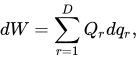
where the index runs over the generalized coordinates , which usually correspond to the degrees of freedom of the system. The function is defined as the mass-weighted sum of the particle accelerations squared,


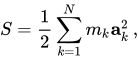
where the index runs over the particles, and


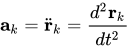
is the acceleration of the -th particle, the second time derivative of its position vector . Each is expressed in terms of generalized coordinates, and is expressed in terms of the generalized accelerations.


Relations to other formulations of classical mechanics
editAppell's formulation does not introduce any new physics to classical mechanics and as such is equivalent to other reformulations of classical mechanics, such as Lagrangian mechanics, and Hamiltonian mechanics. All classical mechanics is contained within Newton's laws of motion. In some cases, Appell's equation of motion may be more convenient than the commonly used Lagrangian mechanics, particularly when nonholonomic constraints are involved. In fact, Appell's equation leads directly to Lagrange's equations of motion.[3] Moreover, it can be used to derive Kane's equations, which are particularly suited for describing the motion of complex spacecraft.[4] Appell's formulation is an application of Gauss' principle of least constraint.[5]
Derivation
editThe change in the particle positions rk for an infinitesimal change in the D generalized coordinates is
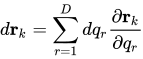
Taking two derivatives with respect to time yields an equivalent equation for the accelerations

The work done by an infinitesimal change dqr in the generalized coordinates is

where Newton's second law for the kth particle

has been used. Substituting the formula for drk and swapping the order of the two summations yields the formulae

Therefore, the generalized forces are

This equals the derivative of S with respect to the generalized accelerations

yielding Appell's equation of motion

Examples
editEuler's equations of rigid body dynamics
editEuler's equations provide an excellent illustration of Appell's formulation.
Consider a rigid body of N particles joined by rigid rods. The rotation of the body may be described by an angular velocity vector , and the corresponding angular acceleration vector


The generalized force for a rotation is the torque , since the work done for an infinitesimal rotation is . The velocity of the -th particle is given by




where is the particle's position in Cartesian coordinates; its corresponding acceleration is

Therefore, the function may be written as

Setting the derivative of S with respect to equal to the torque yields Euler's equations




See also
edit
References
edit- ^ Gibbs, JW (1879). "On the Fundamental Formulae of Dynamics". American Journal of Mathematics. 2 (1): 49–64. doi:10.2307/2369196. JSTOR 2369196.
- ^ Appell, P (1900). "Sur une forme générale des équations de la dynamique". Journal für die reine und angewandte Mathematik. 121: 310–?.
- ^ Deslodge, Edward A. (1988). "The Gibbs–Appell equations of motion" (PDF). American Journal of Physics. 56 (9): 841–46. Bibcode:1988AmJPh..56..841D. doi:10.1119/1.15463. S2CID 123074999.
- ^ Deslodge, Edward A. (1987). "Relationship between Kane's equations and the Gibbs-Appell equations". Journal of Guidance, Control, and Dynamics. 10 (1). American Institute of Aeronautics and Astronautics: 120–22. Bibcode:1987JGCD...10..120D. doi:10.2514/3.20192.
- ^ Lewis, Andrew D. (August 1996). "The geometry of the Gibbs-Appell equations and Gauss' principle of least constraint" (PDF). Reports on Mathematical Physics. 38 (1): 11–28. Bibcode:1996RpMP...38...11L. doi:10.1016/0034-4877(96)87675-0.
Further reading
edit- Pars, LA (1965). A Treatise on Analytical Dynamics. Woodbridge, Connecticut: Ox Bow Press. pp. 197–227, 631–632.
- Whittaker, ET (1937). A Treatise on the Analytical Dynamics of Particles and Rigid Bodies, with an Introduction to the Problem of Three Bodies (4th ed.). New York: Dover Publications. ISBN.
- Seeger (1930). "Appell's equations". Journal of the Washington Academy of Sciences. 20: 481–484.
- Brell, H (1913). "Nachweis der Aquivalenz des verallgemeinerten Prinzipes der kleinsten Aktion mit dem Prinzip des kleinsten Zwanges". Wien. Sitz. 122: 933–944. Connection of Appell's formulation with the principle of least action.
- PDF copy of Appell's article at Goettingen University
- PDF copy of a second article on Appell's equations and Gauss's principle

